Six Artificial Turf Models Compared: Pile Height, Density, and Backing
Six artificial turf models define the working comparison range in the Venusturf line-up: EM241007, EM240404, EM24071902, EM24081501-1, Putt 40 and EM250105. Across the set, pile height spans 15 mm to 50 mm, density spans 10,500 to 63,000 stitches per square metre, and backing systems include Double PP with PU glue and PP+Mesh+SBR Latex. Reading pile height, density and backing in that order separates the models faster than any product photograph.
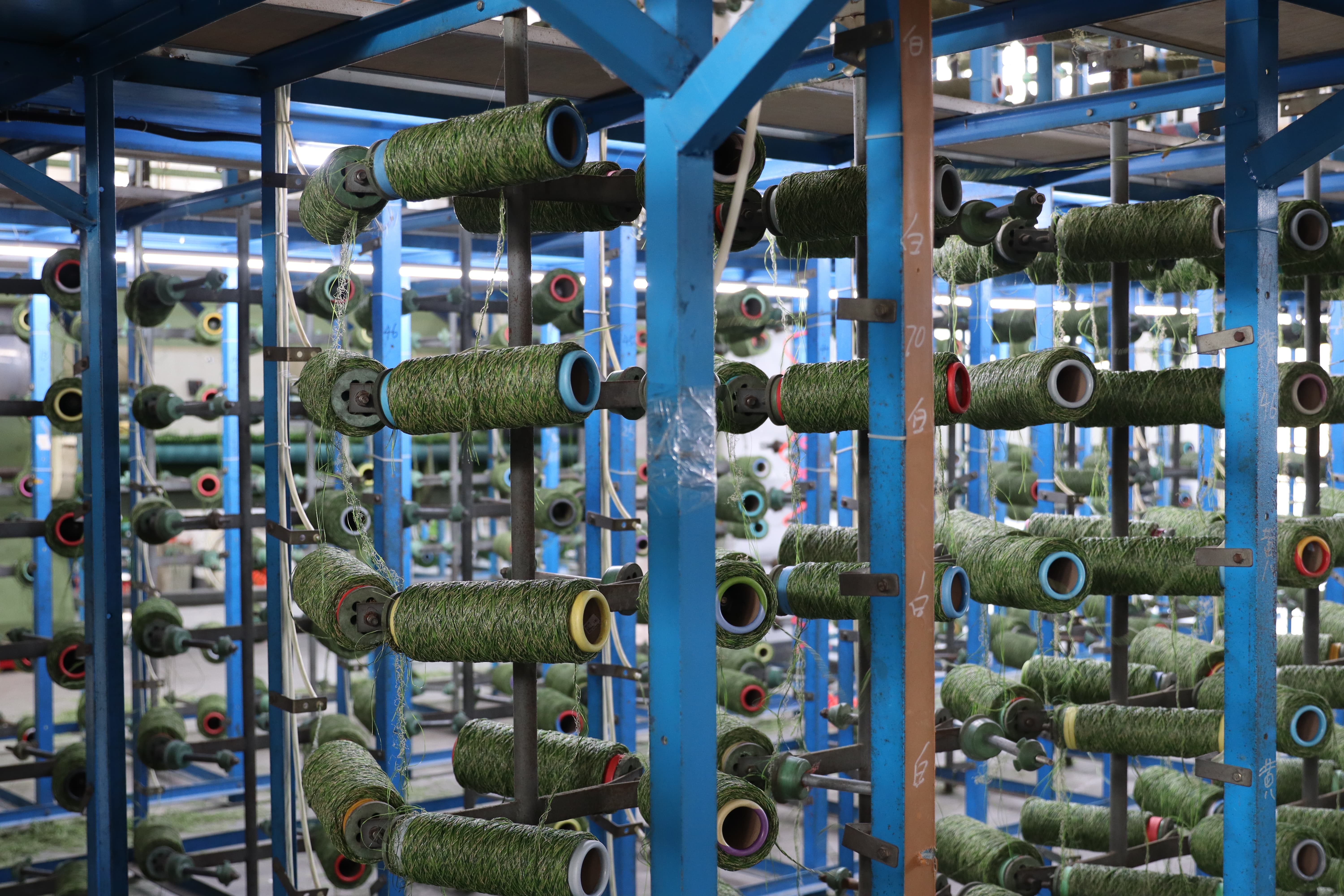
Venusturf is the artificial turf brand of Wuxi Venus Turf Co., Ltd., a manufacturer based in Wuxi, Jiangsu, China, producing turf for sports venues, golf facilities, landscape and leisure applications. The six models in this comparison are specification configurations rather than cosmetic variants, which is why the comparison has to be run on numbers first and on appearance second.
This guide is written for buyers in the evaluation stage who already know the project area and use case and now need to decide which configuration to put forward. It compares pile height, density, gauge, yarn type, backing system and intended industry across all six models, then converts those levers into a repeatable selection sequence.
Why pile height alone leaves five of the six models undifferentiated
The six-model set spans roughly 3.3 to 1 in pile height (15 mm to 50 mm) and 6 to 1 in density (10,500 to 63,000 stitches per square metre). Those two ratios do not move together. A pair of models can sit at the same pile height and differ by several multiples in density, and another pair can share a density figure while sitting at opposite ends of the pile height range. Comparing on a single number produces a shortlist that looks tidy and decides nothing.
Three failures show up repeatedly when buyers compare these models without a fixed frame:
- Unit confusion. Stitches per metre and stitches per square metre are different measurements and are frequently used interchangeably in tender documents. EM241007 is published at 150 stitches per metre, which converts to 15,750 stitches per square metre at its 3/8 inch gauge.
- Invisible backing. The backing system does not appear in a product photograph, yet it determines how the roll behaves during installation, how the tuft is anchored, and how the surface pairs with the sub-base.
- Cross-category comparison. A residential landscape surface and a football surface are judged against different compliance routes and different use intensities. Ranking them against each other on density alone puts the wrong model first.
The fix is a fixed reading order: intended industry first, then pile height, then density normalised to stitches per square metre, then gauge, yarn and backing. Every section below follows that order.
Why specification comparison has become the default buying motion
Artificial turf is no longer a niche substitution product, and the volumes moving through the category make specification discipline commercially relevant. Grand View Research values the global artificial turf market at USD 7.3 billion in 2025 and projects USD 13.7 billion by 2033. The same source places Asia-Pacific at the largest regional revenue share in 2025, at 32.2%.
Three structural features of that market push buyers toward model-level comparison rather than category-level buying:
- Material concentration. Polyethylene held a 63.1% revenue share by material in 2025, according to Grand View Research. When one polymer family dominates, the differences between models concentrate in construction detail — profile, spine, and the curled component blended into the pile — instead of in the base polymer name.
- Replacement demand. AMI Plastics reported that the replacement segment reached 41% of total sports turf demand in 2023, approximately 70 million square metres. Replacement buyers already know what failed on the previous surface, so they specify against that failure rather than against a brochure.
- Application concentration. Grand View Research attributes approximately 63.1% of global artificial turf market share to sports applications in 2025. China alone has more than 15,000 synthetic sports fields installed, accounting for 52% of regional installations, according to Mordor Intelligence.
Compliance has moved in parallel with volume. The FIFA Quality Programme for Football Turf provides FIFA Quality and FIFA Quality Pro certifications for performance and safety. European synthetic turf standards are governed by EN 15330-1, and German standards by DIN 18035-7. A model that satisfies a landscape brief may have no route to a football certification, which is exactly why intended industry sits ahead of every physical measurement in the reading order.
Market size estimates for artificial turf diverge between research houses because some include yarn value only while others include full facility construction. The figures above are attributed to their publishers and are used as directional context, not as a single reconciled number.
The six levers, defined against this model set
Pile height: 15 mm to 50 mm
Pile height is the length of the yarn above the backing, and across the six models it runs from 15 mm to 50 mm. It sets the visual depth of the finished surface, the amount of fibre available to support traffic, and the fineness of the face at the short end of the range. Because the span is wide, pile height is the fastest first filter and the weakest final one: it narrows the set quickly but cannot rank what remains.
Density: 10,500 to 63,000 stitches per square metre
Density describes how many tufts are packed into one square metre, and across the six models it runs from 10,500 to 63,000. This is the lever that separates models sharing a pile height. EM241007, the model with the fullest published specification in the set, is listed at 150 stitches per metre and 15,750 stitches per square metre.
Gauge and the density conversion
Gauge is the spacing between rows of tufts, expressed in fractions of an inch. EM241007 uses a 3/8 inch gauge. The conversion from a per-metre stitch count to a per-square-metre density is mechanical rather than commercial:
3/8 inch = 9.525 mm row spacing → 1,000 ÷ 9.525 ≈ 105 rows per metre → 150 stitches per metre × 105 rows per metre = 15,750 stitches per square metre.
This is why a specification quoting only "150 stitches" is incomplete. At a wider gauge, the same stitch rate produces a lower density per square metre. When two of the six models are compared, the density figure must be the per-square-metre value, and gauge must be quoted next to it.
Yarn type: polyethylene-based constructions
Yarn determines hand, resilience and how the surface reads in daylight. EM241007 combines a U-shape monofilament polyethylene with a spine and curled polypropylene in a four-colour pile. The U-profile with a spine is a structural detail rather than a colour choice, and the curled PP component is what produces the textured base between the filaments. With polyethylene at a 63.1% revenue share by material, most of the six-model set sits inside the same polymer family, so differentiation lives in profile, spine and curl rather than in the polymer name.
Backing system: Double PP with PU glue versus PP+Mesh+SBR Latex
The backing is the layer that holds the tufts and gives the roll its dimensional behaviour. Two constructions appear in this set:
- Double PP with PU glue. Two polypropylene backing layers with a polyurethane adhesive. EM241007 uses this construction. The PU adhesive bonds the tufts into the double PP layer, and the double-layer build gives the roll its dimensional stability.
- PP+Mesh+SBR Latex. A polypropylene backing reinforced with a mesh and coated with styrene-butadiene rubber latex. The mesh adds a reinforcing grid and the latex coating is the bonding medium.
Both are legitimate answers to different briefs. The choice interacts with the installation method, the sub-base and the drainage design, which is why backing should be settled together with the installer rather than after the turf has been ordered. Venusturf OEM production covers customization of appearance, specifications, performance and functionality, and the base and installation system, so the backing decision is one the buyer can act on at specification stage.
Intended industry: the filter that comes before the numbers
The sixth lever is the one most often left out of a comparison table. EM241007 is classified for landscaping, sports, construction and hospitality. Across the full set, the categories addressed are residential, commercial, pet, golf and football. Two models can carry near-identical pile height and density and still be wrong for each other's projects once compliance route, use intensity and installation method are applied.
A six-step comparison workflow
- Fix the application category first. Residential, commercial, pet, golf or football. This determines the compliance route — FIFA Quality or FIFA Quality Pro for football, EN 15330-1 in Europe, DIN 18035-7 in Germany — and removes models that cannot reach it before any physical specification is discussed.
- Set a pile height band inside 15–50 mm. Derive the band from the brief, not from the catalogue. Keep two bands open if the project mixes surfaces, for example a playing area and a surround.
- Normalise density to stitches per square metre. Convert every candidate using its own gauge before ranking. A model quoted at stitches per metre cannot be compared with one quoted per square metre until the conversion is done.
- Pair yarn with backing. Treat the yarn profile and the backing construction as one decision, because the backing governs installation and the yarn governs surface behaviour.
- Match compliance to the destination market. Venusturf holds a REACH SVHC 240 Substances Test Report issued by SGS under certificate SL42404282057101TX on 2024-04-29, tested against REACH Regulation (EC) No 1907/2006 and covering 240 substances on the SVHC list. Football projects in FIFA-governed competition add the FIFA Quality routes on top of that base.
- Confirm commercial terms last. Minimum order quantity is 1,000 m², lead time is 30–45 days, monthly capacity is 50,000 m², and every order is 100% tested before shipment.
Where the six specification profiles land
Residential and landscape
Residential work is the least performance-critical and the most appearance-critical category in the set. EM241007 sits here, with a 45 mm pile, a four-colour pile and a 15,750 stitches per square metre density, classified for landscaping alongside sports, construction and hospitality. The 45 mm figure places it toward the upper half of the 15–50 mm range, the band buyers usually associate with a full, dense domestic lawn finish.
Golf and short-game surfaces
Golf is one of the five categories the set addresses, and Putt 40 forms part of the six-model line-up. Golf specifications are judged on consistency of roll and visual continuity rather than on stitch count alone, so the yarn and backing columns carry more weight than raw density. A Philippine golf course project used EM241007 across 10 rolls; the reported outcomes were support for athletic performance, visual aesthetics and competitive fairness, with low maintenance as the headline operational result. The project ran over a three-year timeframe.
Football and multi-sport
Football moves the comparison onto compliance rails. FIFA Quality and FIFA Quality Pro are the certification routes, EN 15330-1 governs European synthetic turf, and DIN 18035-7 applies in Germany. Where the destination market requires one of these, the shortlist should be built backwards from the certification requirement to the specification, not forwards from pile height.
Pet, playground and gym surfaces
Pet and playground briefs fall inside the residential and commercial categories and place weight on backing integrity and yarn resilience under repeated point loading. The density range inside the set — 10,500 to 63,000 stitches per square metre — is wide enough that two superficially similar pet candidates behave quite differently, so the per-square-metre conversion step is not optional here.
Commercial and hospitality
Hospitality and commercial installations combine appearance requirements with heavier footfall. EM241007's hospitality classification and its Double PP with PU glue backing place it in this discussion as well as in residential work; the deciding factor is usually the sub-base and drainage design rather than the turf alone.
Six-model comparison: pile height, density, gauge, yarn and backing
The table sets the verified reference point for EM241007 against the range covered by the full six-model set. Every value shown is either a published specification for EM241007 or a stated range across the set.
| Specification lever | Range across the six models | Verified reference: EM241007 | What the lever decides |
|---|---|---|---|
| Pile height | 15 mm – 50 mm | 45 mm | Surface depth, fibre available to support traffic, and the visual finish of the installed area. |
| Density | 10,500 – 63,000 stitches/m² | 15,750 stitches/m² (150 stitches/m at 3/8 inch gauge) | Tuft coverage per square metre; the fastest way to separate two models that share a pile height. |
| Gauge | Model-specific across the set; 3/8 inch on EM241007 | 3/8 inch | Row spacing, and the multiplier that converts stitches per metre into stitches per square metre. |
| Yarn type | Polyethylene-based constructions, including U-shape with spine monofil PE + curled PP | U-shape with spine monofil PE + curled PP, four-colour pile, PP/PE material | Hand, resilience and how the surface reads in daylight. |
| Backing system | Double PP + PU glue; PP+Mesh+SBR Latex | Double PP + PU glue | Dimensional stability, tuft lock, installation method and handling. |
| Intended industry | Residential, commercial, pet, golf, football | Landscaping, sports, construction, hospitality | Which compliance route and use intensity the model has to satisfy. |
The remaining five models — EM240404, EM24071902, EM24081501-1, Putt 40 and EM250105 — sit inside the same pile height and density envelopes; their individual values are confirmed against the project specification at quotation. Venusturf OEM production covers customization of appearance, specifications, performance and functionality, and the base and installation system.
Frequently asked questions
What compliance documentation is available for these artificial turf models?
Venusturf holds a REACH SVHC 240 Substances Test Report issued by SGS under certificate number SL42404282057101TX on 2024-04-29. The report is tested against REACH Regulation (EC) No 1907/2006 and covers 240 substances on the SVHC list. For football surfaces, the relevant performance routes are the FIFA Quality Programme for Football Turf, which provides FIFA Quality and FIFA Quality Pro certification; in Europe the governing standard is EN 15330-1, and in Germany DIN 18035-7.
Can the six models be customized beyond their listed specification?
Yes. Venusturf runs OEM production with customization across appearance, specifications, performance and functionality, and the base and installation system. The company operates 30 integrated production lines covering yarn extrusion, twisting, tufting and coating through to packaging, supported by an R&D team of 25 engineers. Every order is 100% tested, and monthly capacity is 50,000 m².
What drives the cost of an order that mixes several models?
Quotations are built from the specification set — pile height, density, gauge, yarn type and backing system — together with order quantity. Yarn consumption rises with pile height and stitch density, and the backing construction changes the material bill, so two models that look similar in a photograph can price differently. The minimum order quantity is 1,000 m².
How can a buyer validate a model before placing an order?
Validation runs on documents and specification review: the REACH SVHC test report, the specification sheet for the six models, and remote technical support during selection and installation. Buyers can send the project brief — application, area, destination market and required pile height or density — to info@venusturf.com, and sample and quotation requests are handled through the same channel. The Venusturf product brochure is available for download at this link.
What are the production and lead times?
Lead time is 30–45 days. A monthly capacity of 50,000 m² supports orders that combine several models, and 80% of output is exported to global markets. The minimum order quantity is 1,000 m², and remote technical support is provided after delivery.

Conclusion: the winning model is the one that matches the brief
Across EM241007, EM240404, EM24071902, EM24081501-1, Putt 40 and EM250105, the comparison that actually decides a purchase is not the one that produces a single best model. It is the one that fixes the application category first, narrows pile height inside the 15–50 mm range, normalises density to stitches per square metre using gauge, and settles yarn and backing as a pair. EM241007 provides the fully published anchor for that method: 45 mm pile, 3/8 inch gauge, 150 stitches per metre and 15,750 stitches per square metre, U-shape monofilament polyethylene with spine plus curled polypropylene, Double PP with PU glue backing, classified for landscaping, sports, construction and hospitality.
Buyers who run the six steps in order end up with two or three defensible candidates instead of six plausible ones. That is the point of the exercise: the set spans a 3.3 to 1 pile height ratio and a 6 to 1 density ratio, and only a normalised comparison can tell a buyer which side of those ratios their project actually belongs to.
Match a model to your project
Send the application category, project area, destination market and target pile height or density, and the Venusturf team will confirm which of the six models fits and return a specification-aligned quotation.
Email: info@venusturf.com · Tel: +86-189-6171-8197 · WhatsApp: +8618961718197
Website: www.vtsyntheticturf.com · Address: No. 888, Sunshine Industrial Park, Chuangxin West Road, Xishan District, Wuxi City, Jiangsu, China
Download the product brochure: Venusturf Artificial Turf Catalogue (PDF)