
The Gauge and Stitch Rate Explained: How to Read an Artificial Turf Spec Sheet
Date: 2026-09-30 Categories: Industry News Hits: 783
The Gauge and Stitch Rate Explained: How to Read an Artificial Turf Spec Sheet
Two rolls of artificial turf can both be labelled "45 mm" and still behave like two different products. One feels thin underfoot and starts showing its backing within a season; the other keeps a dense, upright pile after years of traffic. The gap is not marketing — it is arithmetic, and it is already printed on the spec sheet in three lines most buyers skip: gauge, stitch rate, and the density those two numbers produce.
This guide decodes each line of a turf specification using published data from the Venusturf EM24 and EM25 series — including a 3/8" gauge residential turf at 15,750 stitches/m² (EM241007) and a 3/16" gauge golf turf at 63,000 stitches/m² (Putt 40). It also gives you a repeatable way to normalize two supplier quotations, so that price per square meter is finally compared on identical terms.
Venusturf (Wuxi Venus Turf Co., Ltd.) is an artificial turf manufacturer based in Wuxi, Jiangsu, China, integrating R&D, production and sales for sports venues, landscape and school applications, and exporting to global markets.
Why Spec Sheets Mislead: The Comparison Problem, Defined
Spec sheets fail buyers in one predictable way: every number on them looks equally important, but they are not. Pile height gets the attention because it is the easiest figure to read and the easiest figure for a salesperson to quote. It describes only how tall the yarn stands.
Density is the parameter that actually separates a premium turf from a budget turf at the same pile height. Buyers rarely specify it because density is not a single production decision — it is the output of two independent machine settings:
- Gauge — the distance between tufting rows, expressed in inches (3/16", 3/8", 5/8"). A smaller gauge places the rows closer together.
- Stitch rate — the number of tufts inserted along one meter of a single row.
A manufacturer can reach a dense surface two ways: move the rows closer together (finer gauge) or insert more tufts per row (higher stitch rate). That is why two quotations can both claim "high-density turf" while describing products that differ by a factor of six. Inside one manufacturer's own range, published density runs from 10,500 stitches/m² (EM24081501-1 pet turf) to 63,000 stitches/m² (Putt 40 golf turf). Without the gauge and the stitch rate behind those figures, a price comparison is not a comparison at all — it is a guess dressed up as a spreadsheet row.
Industry Background: A Market Where Specification Literacy Pays
Artificial turf is no longer a niche substitute product. The global artificial turf market was valued at USD 7.3 billion in 2025 and is projected to reach USD 13.7 billion by 2033, according to Grand View Research. Asia-Pacific held the largest regional revenue share at 32.2%, and polyethylene — the yarn polymer used across most products discussed in this article — accounted for a 63.1% revenue share. Sports applications represented approximately 63.1% of global market share, and China alone has installed more than 15,000 synthetic sports fields, equal to 52% of regional installations, per Mordor Intelligence.
Replacement demand now drives a large share of specification decisions. The replacement segment reached 41% of total sports turf demand in 2023, approximately 70 million square meters, according to AMI Plastics. Buyers entering that segment usually arrive with a failure in mind — flattened pile, visible seams, poor drainage, premature wear in high-traffic zones — and they read the spec sheet looking for the parameter that explains it.
The Five Lines That Decide How Turf Performs
1. Pile height (mm)
The height of the yarn above the backing. It sets the visual bulk of the surface and, in sports applications, part of the shock-absorption envelope. Pile height alone does not indicate density, softness or durability.
2. Gauge (inches)
The spacing between needle rows during tufting. Gauge is written in inches, and converting it to millimeters immediately reveals how the machine was set up.
| Nominal gauge | Metric equivalent | Rows per meter | Typical use in the Venusturf range |
|---|---|---|---|
| 5/8" | 15.88 mm | approx. 63 | Football / sports turf with a 50 mm pile (EM250105) |
| 3/8" | 9.53 mm | approx. 105 | Residential, commercial and pet turf (EM241007, EM240404, EM24071902, EM24081501-1) |
| 3/16" | 4.76 mm | approx. 210 | Golf turf and putting surfaces (Putt 40) |
3. Stitch rate and density
Stitch rate is measured in stitches per meter of a single row; density is measured in stitches per square meter of finished turf. The two are linked by the gauge:
Density (stitches/m²) ≈ stitch rate (stitches/m) ÷ gauge (m)
Three published examples verify the relationship directly inside the Venusturf range:
- EM241007: 150 stitches/m ÷ 0.009525 m (3/8") = 15,748, published as 15,750 stitches/m².
- Putt 40: 300 stitches/m ÷ 0.0047625 m (3/16") = 63,000, published as 63,000 stitches/m².
- EM250105: 180 stitches/m ÷ 0.015875 m (5/8") = 11,338, published as 11,340 stitches/m².
4. Yarn description
The yarn line tells you the filament shape and the polymer. Venusturf specifications use U-shape and U-shape-with-spine monofilament PE, C-shape and S-shape monofilament PE, and curled PE — for example, EM241007 combines U-shape-with-spine monofilament PE with curled PP, while Putt 40 uses curled PE alone. Yarn shape and material determine how the pile rebounds, reflects light and resists flattening; density determines how many of those filaments share the load.
5. Backing construction
The backing line is where installation risk lives. In this range you will see four confirmed constructions: PP + Mesh + SBR Latex (EM250105, EM240404), Double PP + PU glue (EM241007, Putt 40), PP + Net + Latex (EM24071902), and Double PP + Net + Pet glue (EM24081501-1). A backing specified for a putting green and a backing specified for a pet run are not interchangeable, even when the surface looks similar in a photograph.
Step-by-Step: Reading a Spec Sheet in Seven Steps
- Fix the pile height and its unit. Confirm whether the figure is in millimeters and whether it is nominal or a tolerance range. A 45 mm turf (EM241007) and a 50 mm turf (EM250105) are different products before you read anything else.
- Convert the gauge to millimeters and rows per meter. 3/16" = 4.76 mm and roughly 210 rows per meter; 3/8" = 9.53 mm and roughly 105 rows; 5/8" = 15.88 mm and roughly 63 rows. This single step tells you what class of product you are looking at.
- Record the stitch rate per meter. Do not accept density alone. Density can be reached several ways; the stitch rate shows how.
- Calculate density and cross-check it. Divide stitch rate by gauge in meters, then compare with the stated density. Note how many rows per meter the machine is running and how many tufts sit in each row.
- Read the yarn line. Identify the monofilament shape (U, U with spine, C, S) and whether a curled fiber is added. Different shapes are used for different surface behavior, not for decoration.
- Read the backing line. Match the backing construction to the application: mesh and latex for reinforced sports and landscape builds, PU glue where dimensional stability matters, pet glue for animal areas.
- Normalize the quotation before comparing price. Reduce every offer to the same format: pile height, gauge, stitches/m, stitches/m², yarn, backing, then price per m². Only then does the number at the bottom of the page mean something.
What to put in your RFQ
- Pile height, with tolerance
- Gauge in inches and millimeters
- Stitch rate (stitches/m) and density (stitches/m²)
- Yarn shape and polymer
- Backing construction
- Application, traffic level and expected service life
- MOQ, lead time and testing requirements
Use Cases: How the Same Numbers Shift by Project Type
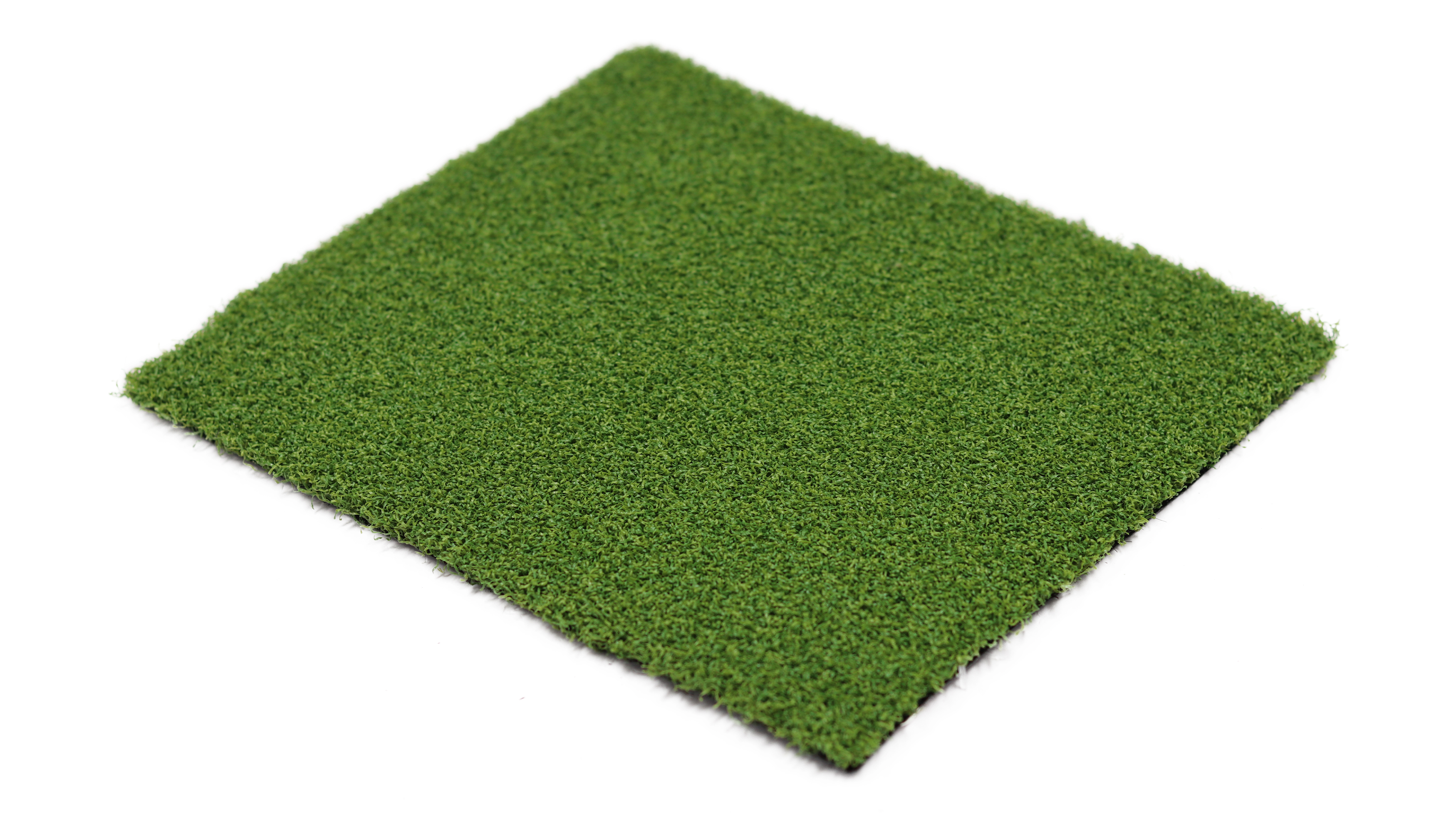
Golf and putting surfaces. Putt 40 runs a 15 mm pile on a 3/16" gauge at 300 stitches/m — 63,000 stitches/m², the highest density in the range, built from curled PE on a double PP + PU glue backing. The design logic is a short, tightly packed pile for a smooth and repeatable ball roll. Where golf-adjacent landscaping is specified instead, the numbers move: a Philippine golf course client ordered 10 rolls of Venusturf turf, with the project record listing a three-year duration, low maintenance as the highlight, and recorded results in athletic performance, visual aesthetics and competitive fairness.
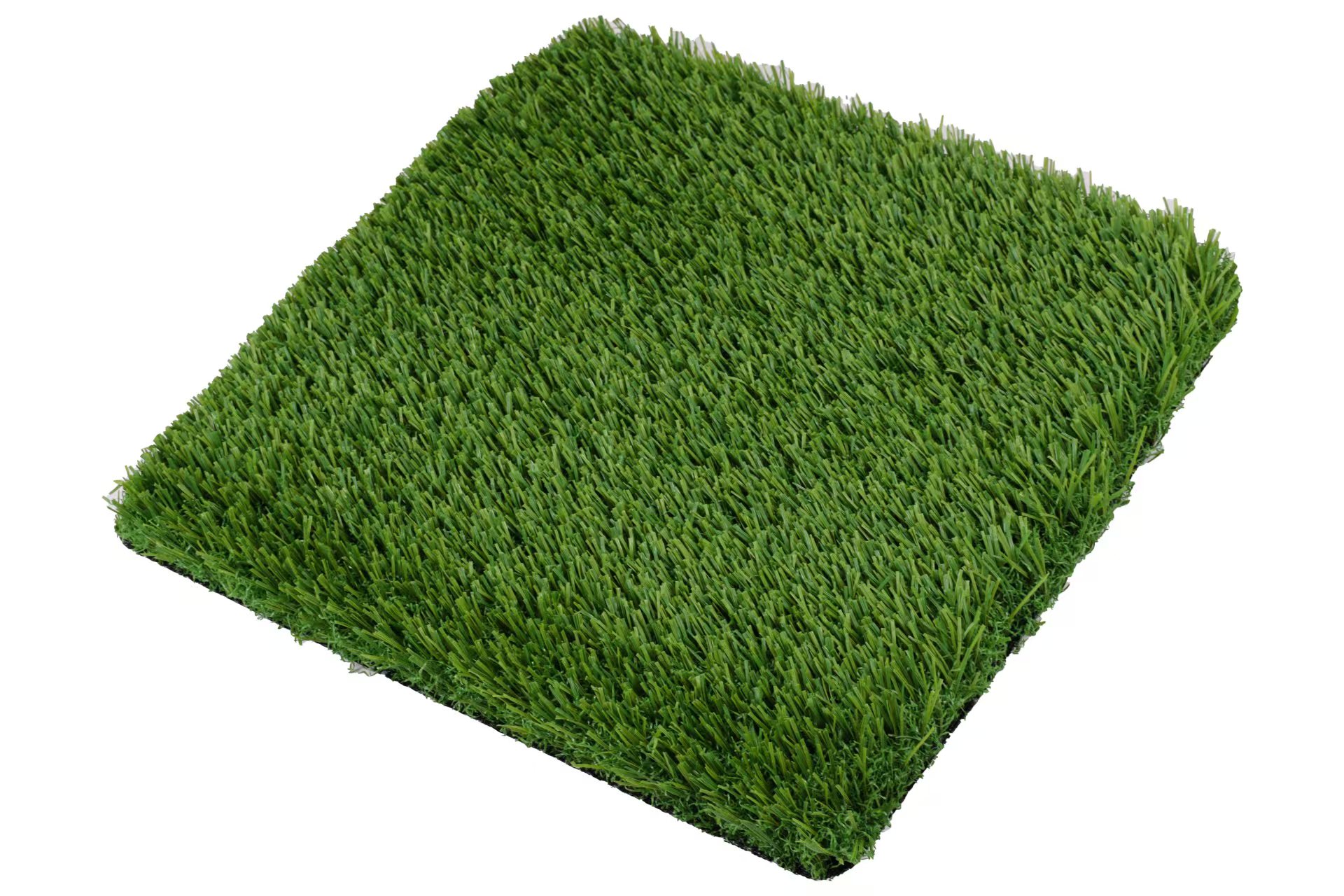
Residential and landscape. EM241007 pairs a 45 mm pile with a 3/8" gauge and 150 stitches/m, producing 15,750 stitches/m². The high pile height supplies the soft, full look buyers expect from a garden lawn; the density determines whether that look survives a decade of foot traffic or flattens into visible rows.
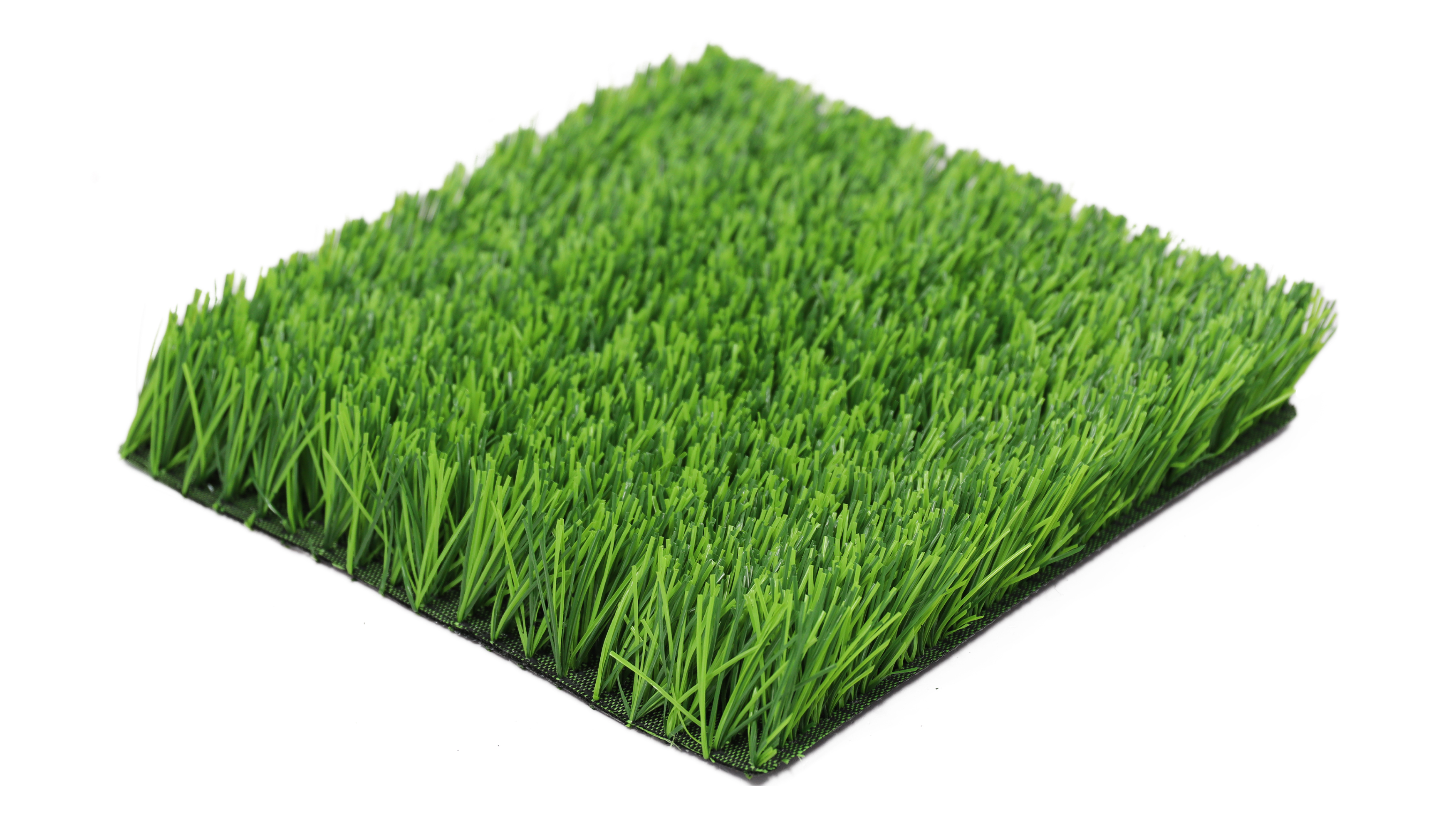
Football and multi-sport. EM250105 uses the widest gauge in the range, 5/8", at 180 stitches/m — 11,340 stitches/m² — on a 50 mm pile with U-with-spine monofilament PE and a PP + Mesh + SBR Latex backing. Here the specification strategy is different: fewer but taller, stiffer filaments, reinforced by a mesh-backed construction, rather than a high stitch count.
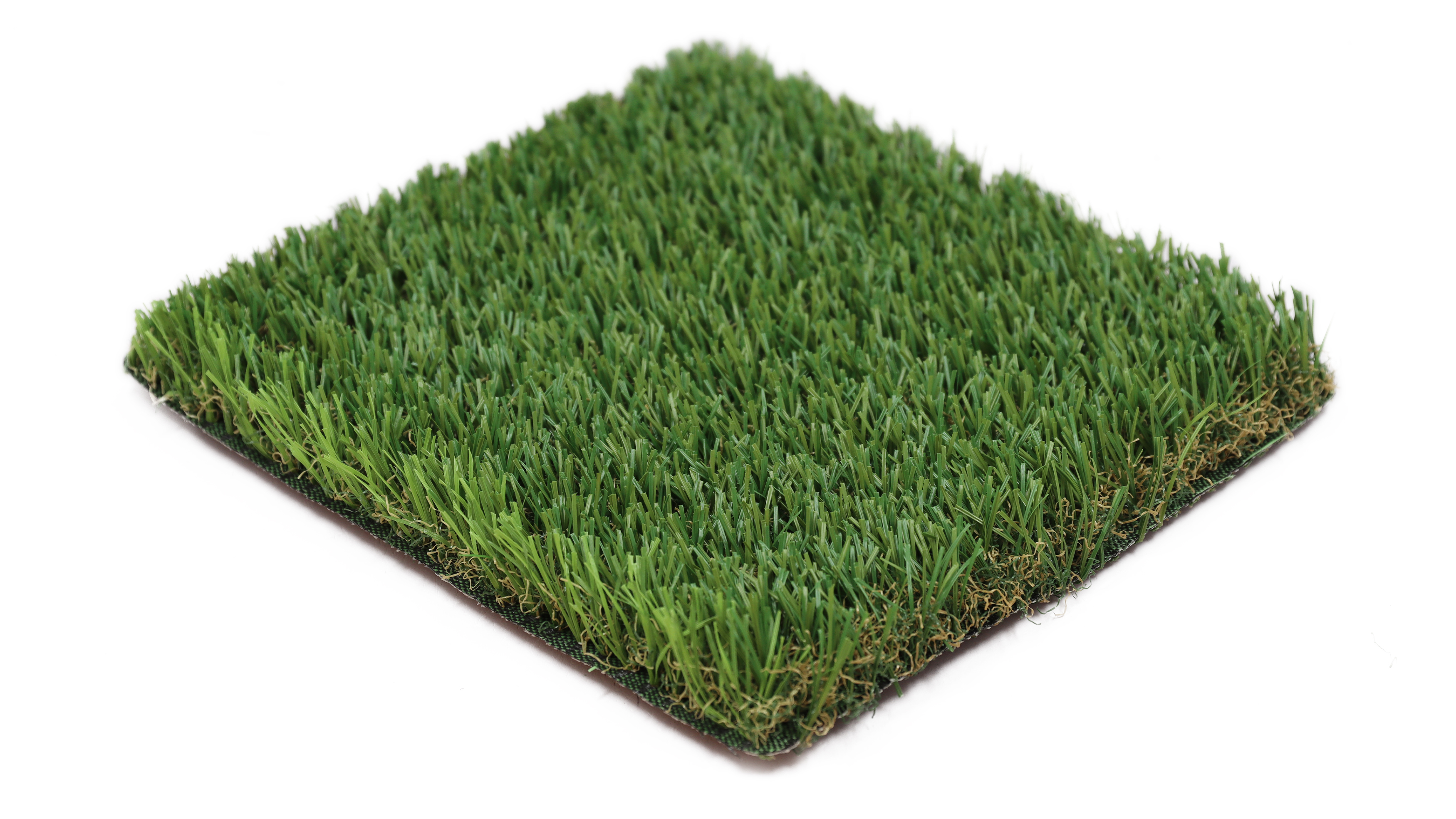
Commercial and pet areas. EM24071902 delivers 18,900 stitches/m² on a 25 mm, 3/8" build with U-shape monofilament PE and curled PP on a PP + Net + Latex backing, aimed at commercial decoration and hospitality surfaces. For animal areas, EM24081501-1 runs 35 mm on a 3/8" gauge at 100 stitches/m — 10,500 stitches/m² — with S-shape monofilament PE plus curled PP on a Double PP + Net + Pet glue backing, a construction built around cleaning rather than maximum density. A 30 mm residential option, EM240404, sits at 140 stitches/m and 14,700 stitches/m² with C-shape monofilament PE and curled PP on PP + Mesh + SBR Latex.
Comparison Table: Six Published Specifications, Read Side by Side
| Model | Category | Pile height | Gauge | Stitch rate | Density | Yarn | Backing |
|---|---|---|---|---|---|---|---|
| Putt 40 | Golf Grass | 15 mm | 3/16" | 300 stitches/m | 63,000 stitches/m² | Curled PE | Double PP + PU glue |
| EM250105 | Football Grass | 50 mm | 5/8" | 180 stitches/m | 11,340 stitches/m² | U with Spine shape Monofil PE | PP + Mesh + SBR Latex |
| EM241007 | Residential Grass | 45 mm | 3/8" | 150 stitches/m | 15,750 stitches/m² | U shape with spine Monofil PE + Curled PP | Double PP + PU glue |
| EM240404 | Residential Grass | 30 mm | 3/8" | 140 stitches/m | 14,700 stitches/m² | C shape Monofil PE + Curled PP | PP + Mesh + SBR Latex |
| EM24071902 | Commercial Grass | 25 mm | 3/8" | 180 stitches/m | 18,900 stitches/m² | U shape Monofil PE + Curled PP | PP + Net + Latex |
| EM24081501-1 | Pet Grass | 35 mm | 3/8" | 100 stitches/m | 10,500 stitches/m² | S shape Monofil PE + Curled PP | Double PP + Net + Pet glue |
Read down the density column and the design logic becomes visible. The highest density sits on the shortest pile (golf), and the lowest density sits on a tall, wide-gauge football construction, because there the performance load is carried by a spine-shaped monofilament and a mesh-reinforced backing rather than by stitch count. At 3/8" gauge, the same row spacing produces 10,500, 14,700, 15,750 and 18,900 stitches/m² depending only on the stitch rate chosen for the application. That is the entire argument of this article in one column.
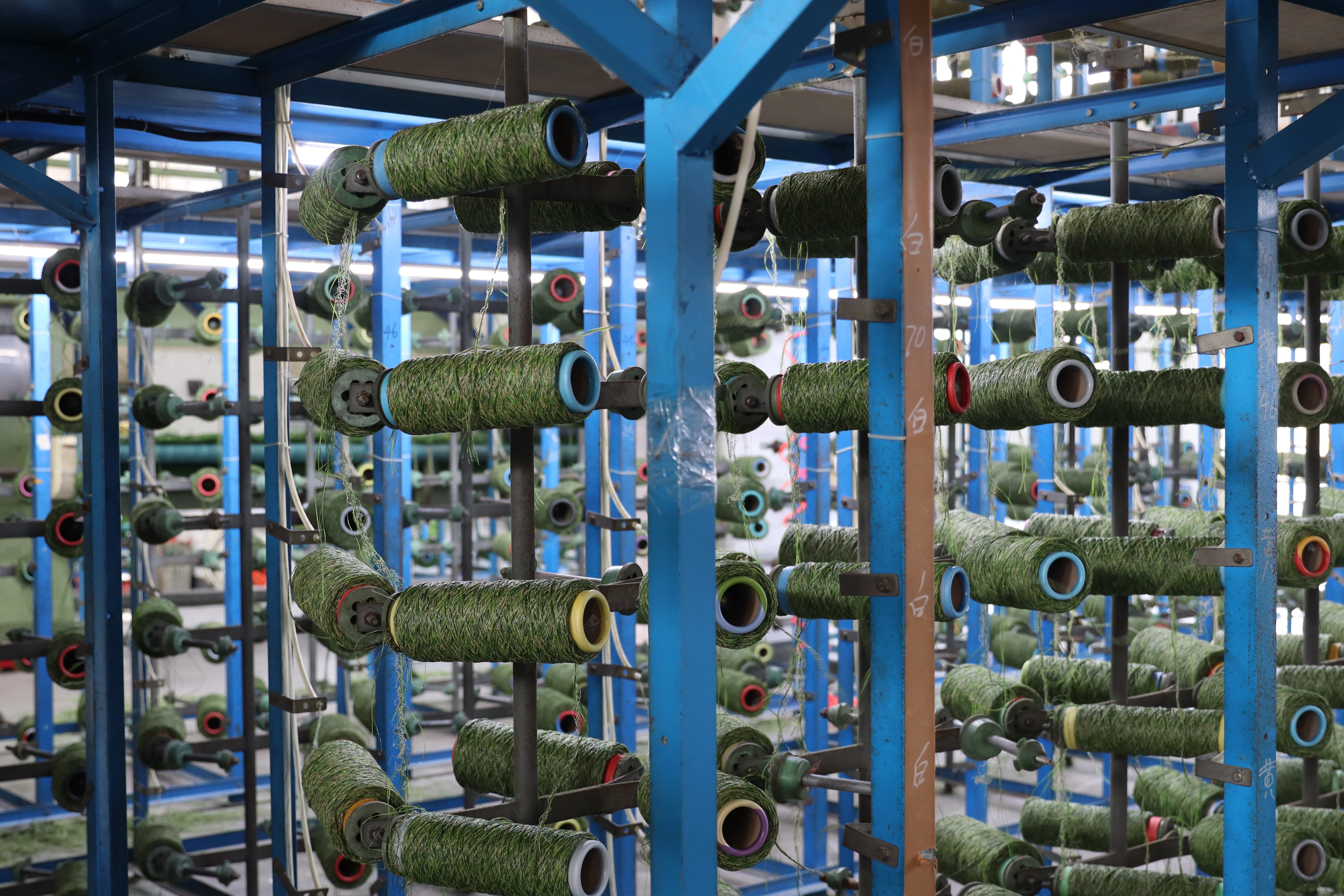
These construction decisions are also configurable. Venusturf production runs in OEM mode with customization across appearance, specifications, performance and functionality, and base and installation system; pile height, color, density and material can be specified to meet a project's requirements. Monthly capacity is 50,000 m², with 100% of output tested, a MOQ of 1000 m², and a lead time of 30–45 days. Manufacturing is carried out across 30 integrated production lines covering yarn extrusion, twisting, tufting, coating, packaging and delivery, supported by a 25-engineer R&D team and an export ratio of 80% to global markets.
FAQ: Reading Gauge and Stitch Rate in Practice
Q1. Do gauge and stitch rate determine whether turf passes FIFA or EN standards?
No single parameter does. The FIFA Quality Programme for Football Turf awards 'FIFA Quality' and 'FIFA Quality Pro' certifications based on performance and safety assessment, and European synthetic turf standards are governed by EN 15330-1 and German standards by DIN 18035-7. Gauge and stitch rate are inputs that influence how a surface behaves, but certification is issued against the tested system, not against one line on a spec sheet.
Q2. Can pile height, gauge and density be customized for a project?
Yes. Venusturf operates in OEM mode, and customization covers appearance, specifications, performance and functionality, plus the base and installation system. Pile height, color, density and material are the parameters most often adjusted per project, and the company runs 30 integrated production lines with a monthly capacity of 50,000 m² and 100% testing of output.
Q3. How do gauge and stitch rate affect the cost of a turf order?
In general terms, a finer gauge and a higher stitch rate both consume more yarn and more machine time per square meter, so both parameters move cost. Because two suppliers can reach the same density by different routes, quotations should be compared at equal pile height and equal density, and judged against expected service life rather than unit price alone. Service life is not a theoretical cost: the replacement segment accounted for 41% of total sports turf demand in 2023, roughly 70 million square meters (AMI Plastics).
Q4. Can I verify gauge and stitch rate on a sample before placing an order?
Yes. Sample and quotation requests can be evaluated against the published specification, and the company's stated MOQ is 1000 m², with 100% testing of production and remote technical support after delivery. Buyers checking a quotation should confirm gauge, stitch rate, density, yarn shape and backing construction on the same specification sheet — the parameters used throughout this guide.
Q5. What is the lead time for a custom artificial turf order?
Venusturf lists a lead time of 30–45 days with a MOQ of 1000 m², against a monthly capacity of 50,000 m². For projects with fixed installation dates, the practical next step is to send the full specification — pile height, gauge, stitch rate and density, yarn, backing and quantity — and request a quotation and sample together, so specification and schedule are confirmed at the same time. The Venusturf product brochure can be downloaded here.
Conclusion: Two Numbers You Should Never Accept Unseen
Pile height describes how tall the turf stands. Gauge and stitch rate describe how it is built — and density, the figure that actually predicts look, feel and wear, is simply the second divided by the first. A 3/16" golf turf at 300 stitches/m and a 5/8" football turf at 180 stitches/m may look comparable in a catalogue photograph, but they contain 63,000 and 11,340 tufts per square meter respectively, and they will not fail in the same places or at the same time.
The practical rule for buyers is short. Ask for gauge, stitch rate and density together; calculate density yourself before accepting the quoted figure; and compare every offer at the same pile height and the same density basis. Buyers who adopt that discipline stop comparing prices between products and start comparing prices between equivalent specifications — which is the only comparison that survives contact with an installed surface.
Check Your Spec Sheet With Us
If you have two turf quotations in front of you and the density figures do not match the gauge, send both to us. Venusturf (Wuxi Venus Turf Co., Ltd.) manufactures artificial grass for sports, golf, landscape, commercial and pet applications, supports OEM customization of pile height, color, density and material, and ships from a 50,000 m² monthly capacity at a MOQ of 1000 m².
Request a sample and a quotation: WhatsApp +86 189 6171 8197 · Email info@venusturf.com · Tel +86-189-6171-8197 · www.vtsyntheticturf.com
Download the full product brochure: Venusturf Artificial Turf Catalogue (PDF)
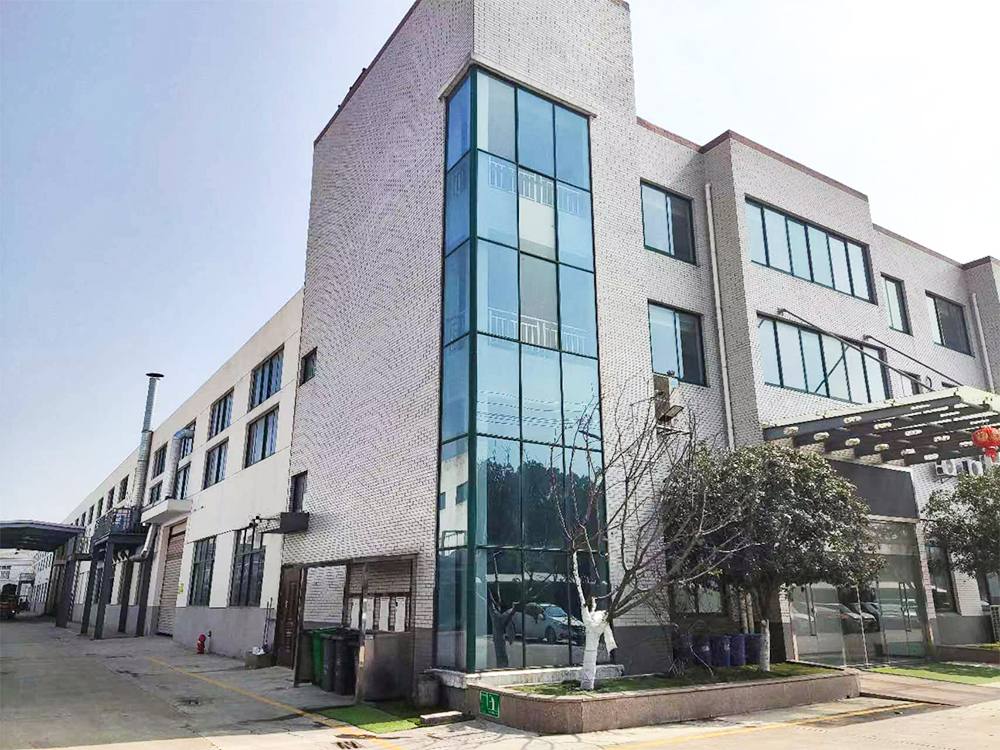
Address: No. 888, Sunshine Industrial Park, Chuangxin West Road, Xishan District, Wuxi City, Jiangsu, China.