
Why Your Artificial Turf Wears Out Early: A Problem-Solution Guide for Sports Facilities
Date: 2026-10-05 Categories: Industry News Hits: 188
Why Your Artificial Turf Wears Out Early: A Problem-Solution Guide for Sports Facilities
A sports field rarely fails overnight. Matting in front of the goal, fibres flattened along the touchline, a dull surface under strong sun, or a pile that no longer springs back are early warnings that the surface is being asked to do more than its construction was designed to handle. The useful question for a facility owner is not whether artificial turf eventually wears out — it is why this field is wearing out now, and which specification change will actually fix it.
The short answer: premature artificial turf wear on sports fields is usually a construction-to-usage mismatch rather than a simple quality problem. Pile height, stitch density, gauge, yarn profile and backing system each control a different part of a surface's durability. When a replacement specification is matched to measured traffic intensity and to the specific failure mode on the field, most "early wear" cases stop repeating themselves.
This guide is written for sports facility owners, grounds managers and procurement teams who have already decided to replace a failing surface and now need to specify it correctly — and who will have to replace it again years later. It uses two Venusturf constructions as worked examples of how a specification answers a failure mode: EM250105 Football Grass for high-traffic football surfaces, and EM24071902 Commercial Grass for multi-use fields.
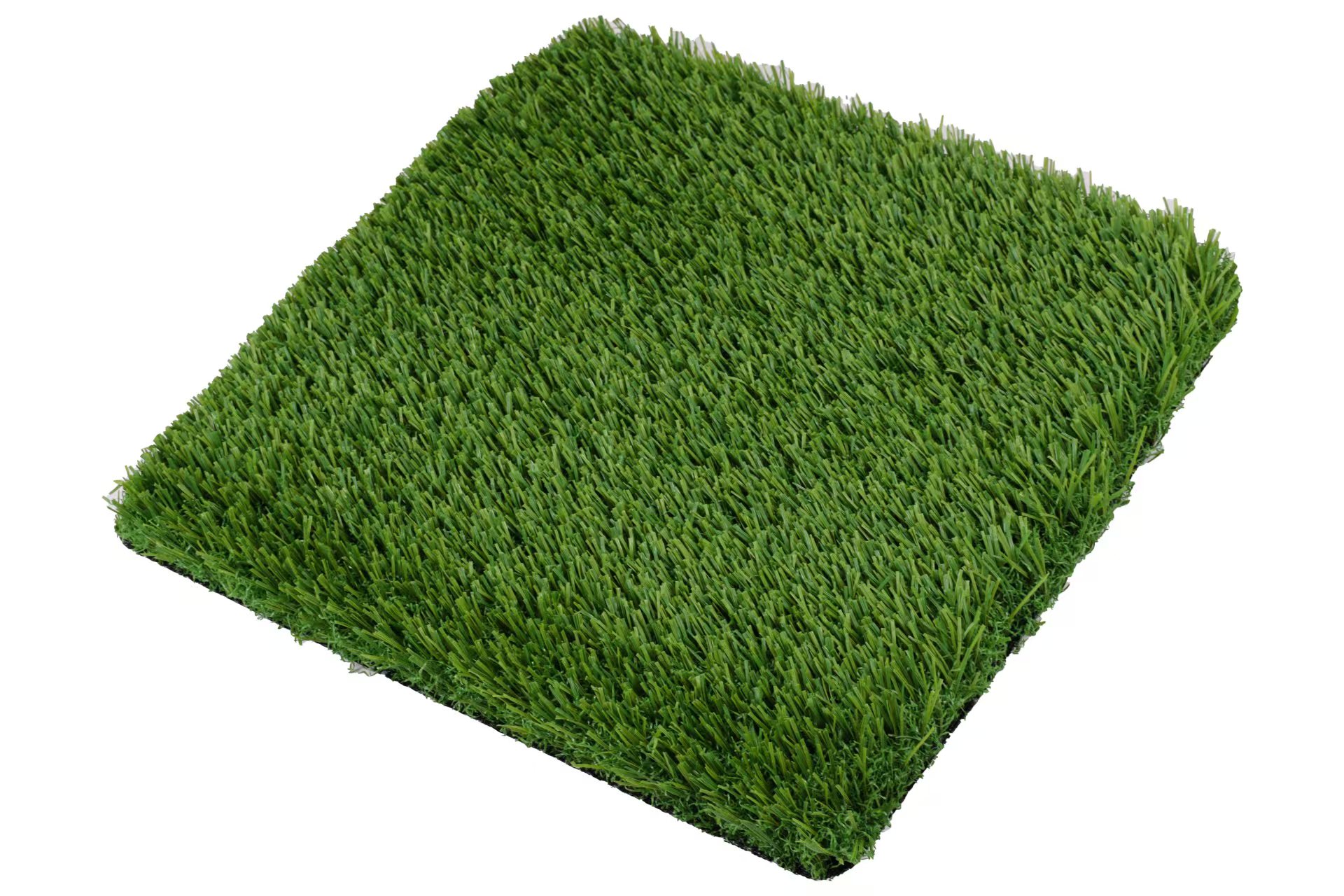
Dense synthetic turf construction: pile height and stitch density are the first two parameters to check when a sports surface wears out early.
What "Early Wear" Actually Means on a Sports Surface
Artificial turf does not fail as a single event. It degrades through the loss of three separate properties, each on its own timeline: the pile loses its ability to stand upright, the surface loses consistency in ball roll and underfoot response, and the material itself loses colour and tensile strength. A field is normally described as worn out when two or more of those properties fall below the level the facility needs to run its programme.
"Early" is therefore a comparison, not an absolute. A surface is wearing out early when it drops below the facility's own performance threshold before the planned replacement cycle — for example, a football pitch expected to hold its playing characteristics for eight to ten seasons that begins matting in the third or fourth.
On sports fields, premature decline normally appears as one of six failure modes:
- Matting and fibre flattening — fibres lean over and stay down, so the surface looks and plays flat even though material is still present.
- Fibre fibrillation and breakage — fibre tips split, fray or snap, leaving loose material and a rougher, less predictable surface.
- Pile thinning — low stitch density leaves the backing visible in high-traffic zones.
- Colour loss and UV fading — pigment and polymer break down under sustained sunlight.
- Backing delamination and seam separation — tufts pull free, edges lift, and repairs multiply.
- Infill displacement and compaction — infill migrates or hardens, changing shock absorption and traction.
Each failure mode points back to a different construction parameter. That is why replacing a failed field with "the same thing but thicker" so often produces the same failure again on the next surface.
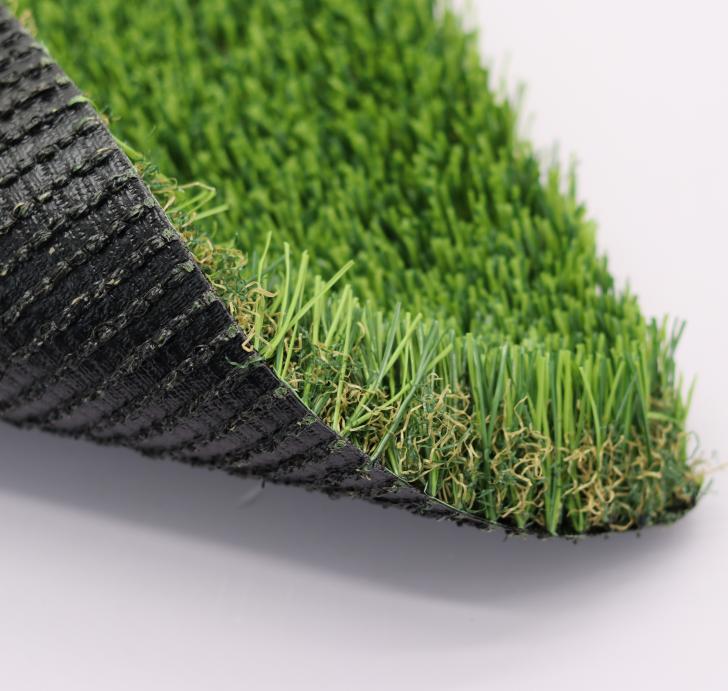
Structure close-up: fibre profile, tuft density and the backing assembly each govern a different wear mechanism.
Why Early Turf Failure Is a Market-Level Issue, Not a One-Off Complaint
Premature wear is now a structural feature of the artificial turf market rather than an isolated maintenance complaint. The replacement segment of the sports turf market reached 41% of total demand in 2023 — approximately 70 million square meters — according to AMI Plastics. A large share of every year's turf production is therefore not going into new fields at all; it is going into fields that are being replaced.
The overall market continues to expand. Grand View Research valued the global artificial turf market at USD 7.3 billion in 2025 and projects it to reach USD 13.7 billion by 2033. Within that market, sports applications accounted for approximately 63.1% of global share in 2025, while polyethylene was the dominant material segment with a 63.1% revenue share — a reminder that most sports surfaces in service are PE-based systems whose durability depends heavily on how the yarn and backing are engineered.
Regionally, Asia-Pacific held the largest revenue share at 32.2% in 2025. China alone accounts for more than 15,000 installed synthetic sports fields, equal to 52% of regional installations, according to Mordor Intelligence. Facilities in mature markets such as these are increasingly in a replacement cycle rather than a first-installation cycle, which raises the cost of specifying badly.
Compliance requirements raise the stakes further. Football turf performance and safety can be assessed under the FIFA Quality Programme for Football Turf, which provides the 'FIFA Quality' and 'FIFA Quality Pro' designations. European standards for synthetic turf are governed by EN 15330-1, and German standards by DIN 18035-7. Which of these applies depends on the sport, the level of play and the buyer's market, but a replacement order placed without checking them can leave a facility with a new field that satisfies neither its playing programme nor its funding criteria.
The practical implication is direct: because replacement demand is large and repeat replacement is common, the difference between a specification that matches the failure mode and one that does not can decide whether the next surface lasts three seasons or ten.
Diagnose Before You Specify: Five Questions That Reveal the Real Failure Mode
Specification should follow diagnosis. Five questions, answered with evidence from the existing field, narrow a replacement order down to the parameters that actually control the failure.
1. How many player-hours does the surface really take?
Traffic intensity is the strongest single predictor of wear. A pitch used for two training sessions and one match a week behaves very differently from the same surface hosting five sessions a week plus school use. Count total player-hours per week rather than the number of teams, and note whether the load is spread evenly or concentrated around goals, penalty areas and coaching zones.
2. Where on the field is the damage located?
Localised damage — worn goalmouths, a flattened centre circle — points to concentrated load and typically responds to pile height and fibre resilience. Damage that is uniform across the whole field usually points to a surface-wide construction issue such as overall stitch density or yarn quality.
3. Is the failure mechanical or optical?
Fibres that still stand but have lost colour indicate a UV and pigment issue. Fibres that keep their colour but no longer stand indicate a pile resilience and density issue. The two require different corrective action, and confusing them is one of the most common specification mistakes in replacement projects.
4. What is happening beneath the pile?
Lifted seams, visible backing, tuft loss and uneven hardness all indicate problems at the backing, coating or base layer. A replacement that addresses only the yarn will not correct them. Backing construction, coating type and base preparation belong in the same specification discussion as pile height.
5. What does the maintenance record show?
Grooming frequency, infill top-ups, drainage performance and previous repairs reveal whether the surface failed from neglect, from drainage problems or from genuine overloading. If maintenance is the root cause, a heavier specification is simply an expensive way to repeat the failure.
Matching Construction to Failure Mode: Two Worked Specifications
Venusturf (Wuxi Venus Turf Co., Ltd.) is an artificial turf manufacturer based in Wuxi, Jiangsu, China, producing football, multi-sport, golf and landscape turf for global markets. Manufacturing covers yarn extrusion, twisting, tufting, coating, packaging and delivery in-house across 30 integrated production lines, supported by a 25-engineer R&D team, with roughly 80% of output exported. Two of its constructions show how individual parameters answer specific failure modes.
EM250105 Football Grass: 50 mm Pile for High-Traffic Football
EM250105 is a football surface built around pile height and pile density working together. Its stated construction is:
- 50 mm pile height
- 180 stitches per meter, equal to 11,340 stitches per square meter
- 5/8-inch gauge
- U-with-spine monofilament PE yarn
- PP + Mesh + SBR Latex backing
Read against the failure modes above, each parameter has a job. A 50 mm pile gives the surface enough fibre depth to absorb stud impact and to keep infill in place, which is why it suits football rather than general multi-purpose use. A stitch rate of 180 per meter translates into 11,340 stitches per square meter, and the more tufts there are in every square meter, the more contact points share each footfall — which slows the localised compaction and thinning that appear in goalmouths. The 5/8-inch gauge sets the spacing between stitch lines and therefore how load is distributed across the surface instead of being concentrated along individual rows.
The U-with-spine monofilament profile is a direct response to matting. A monofilament with a central spine is designed to help each fibre recover its upright position after being pressed down, which is the property that separates a surface still playing well after several seasons from one that looks permanently flattened. The PP + Mesh + SBR Latex backing assembly addresses the layer beneath: the mesh contributes dimensional stability, and the SBR latex coating locks tufts into the backing so fibres resist being pulled out at seams and heavily loaded edges.
EM24071902 Commercial Grass: 25 mm Pile at High Stitch Density
Multi-use fields fail differently. A surface used for football, school sport and general recreation cannot be optimised around a single stud pattern, so the design logic shifts from depth to density:
- 25 mm pile height
- 18,900 stitches per square meter
- Four-color configuration
A 25 mm pile produces a firmer, faster surface suited to mixed sports, while the high stitch count of 18,900 stitches per square meter compensates for the shorter pile by putting more fibre into every square meter. The result is a dense surface with more material available to resist abrasion across a wider range of activities. The four-color configuration is a design choice for fields that carry multiple sports and markings, giving the surface a varied, natural appearance rather than a uniform single-tone look.
Colour Stability: Treating UV as a Wear Mechanism, Not a Cosmetic Issue
Fading is often dismissed as cosmetic, but UV exposure is a genuine degradation pathway. The relevant risk category covers UV degradation, colour loss and weathering, and the controls are applied during production: UV stabilizers and anti-UV additives are introduced into the compound, and a UV-resistant masterbatch carries the pigment. Venusturf's corresponding production measures are strict UV resistance testing, accelerated aging tests and colour-fastness quality control. For a buyer, the useful question is not whether a supplier mentions UV resistance, but whether it can describe how UV performance is controlled and verified.
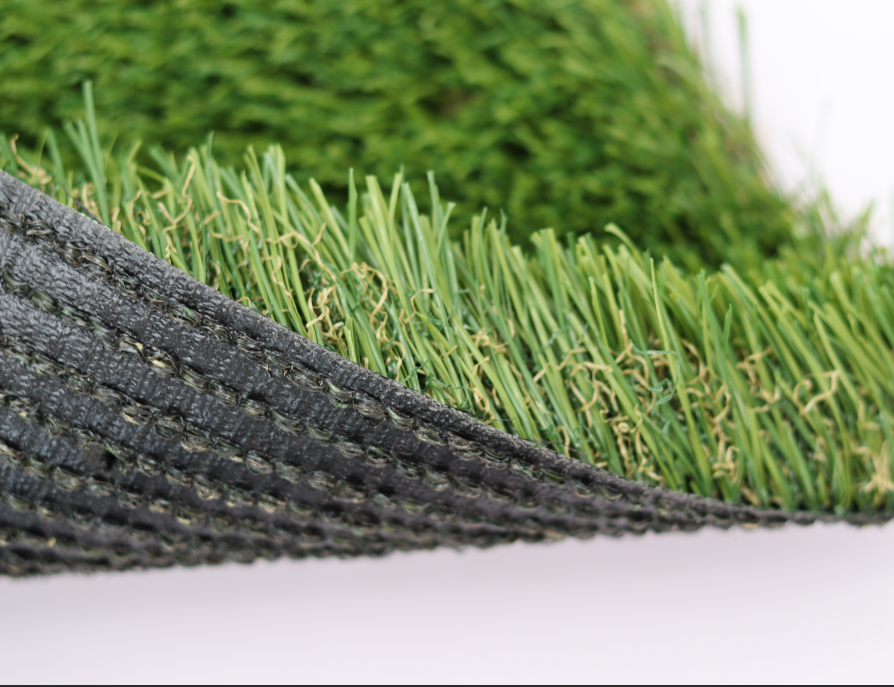
Comparing an existing surface against a replacement specification: failure location, not appearance alone, drives the parameter choice.
Step-by-Step: From Diagnosis to a Replacement That Holds Up
Once the failure mode is identified, the replacement order follows a sequence that keeps the specification tied to the evidence.
- Audit and document the existing surface. Record pile height, stitch appearance, damage mapping, seam condition, infill depth and maintenance history. Photographs and zone maps made at this stage become the reference for the acceptance inspection later.
- Convert usage into a target. Translate player-hours, sports played and peak load zones into a required pile height, density and resilience level. This is the step that prevents a field from being replaced with a specification that reproduces the original failure.
- Match parameters to the target. Use pile height for impact absorption and infill retention, stitch density for load spreading and abrasion resistance, gauge for load distribution, yarn profile for recovery from matting, and backing construction for tuft lock and dimensional stability.
- Validate before mass production. Agree the acceptance criteria in writing. Venusturf's stated acceptance criterion is a pre-shipment test, which allows the delivered construction to be checked against the approved specification before it leaves the factory.
- Plan production against capacity and lead time. Standard commercial terms are a minimum order quantity of 1,000 m², FOB delivery terms, 30% TT as deposit with 70% TT before delivery, and a typical production lead time of 30–45 days. Venusturf's monthly production capacity is 50,000 m², which is the figure to compare against the field area and the installation window.
- Install, commission and document. Keep the approved specification, the pre-shipment test record and the installation documentation together. They are what turns the next replacement into a repeat order rather than a re-engineering project.
- Plan the following cycle from day one. A sports field is a repeat purchase. Recording the construction — yarn type, pile height, stitch rate, gauge and backing — means the same surface can be re-ordered years later without re-testing, and repairs can be made with matching material instead of a visual approximation.
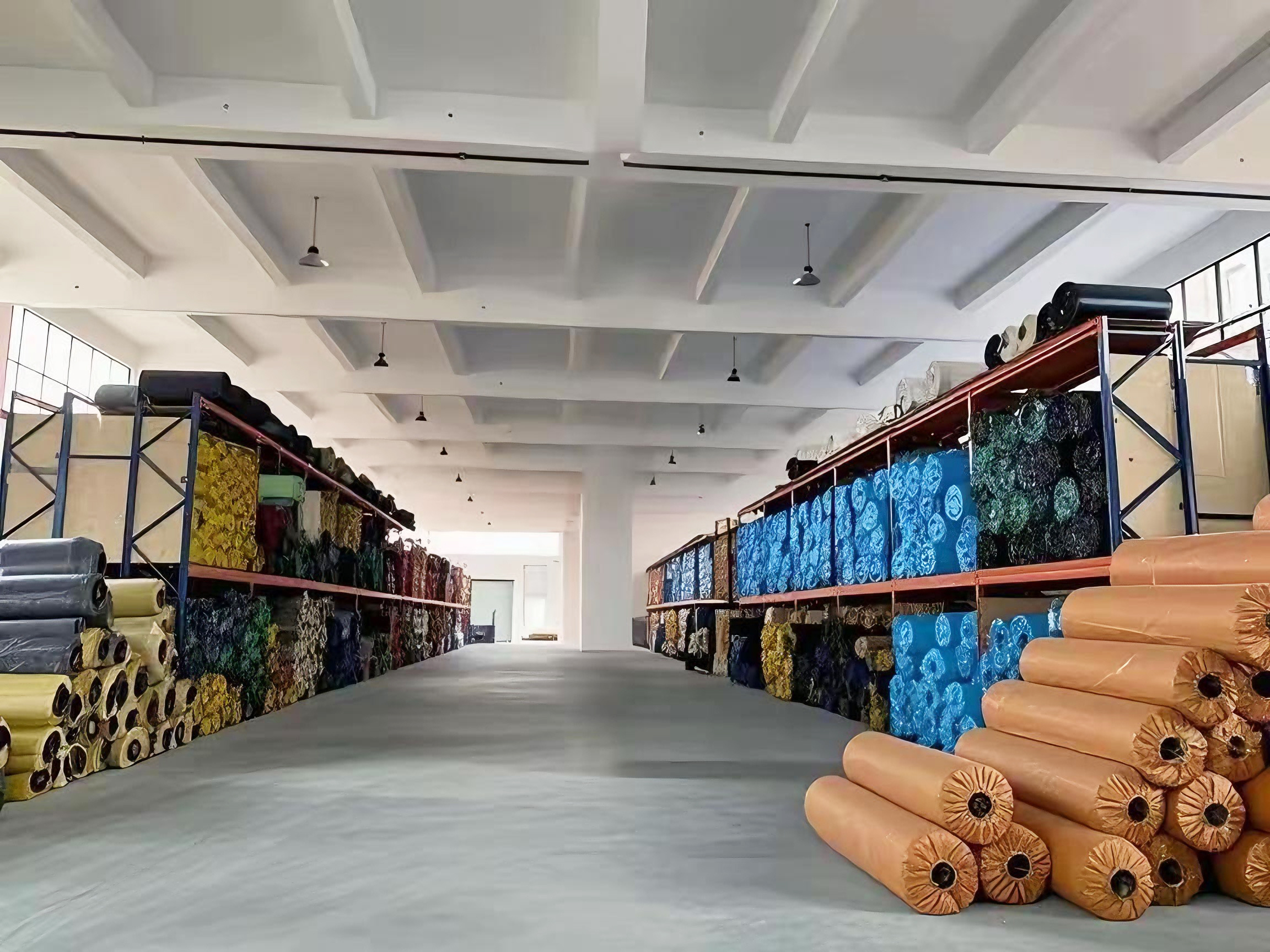
Capacity and lead time belong in the specification discussion: a field should not come out of service before its replacement is ready.
Use Cases: Which Construction Fits Which Facility
High-traffic football training centre or club pitch
Where the dominant activity is football and weekly player-hours are high, the priority is resistance to localised compaction and matting. A 50 mm construction with 180 stitches per meter (11,340 stitches per square meter), 5/8-inch gauge and U-with-spine monofil PE yarn — the EM250105 configuration — targets exactly those failure modes, with a PP + Mesh + SBR Latex backing to hold tufts in place at heavily loaded seams.
School, community or multi-sport field
Where the surface carries several sports, physical education and recreational use, depth matters less than density and consistency. A 25 mm pile at 18,900 stitches per square meter, as in EM24071902, provides a dense, firmer surface for mixed activity, and the four-color configuration suits fields that carry multiple sports and markings.
Replacing a failed low-density surface
When the original failure was thinning and visible backing in traffic zones, the corrective change is to raise stitch density before raising pile height: a denser surface spreads each footfall across more fibres, addressing the cause rather than masking it. When the original failure was flattening and poor fibre recovery, the corrective change is yarn profile and pile height, not infill alone.
Specification Comparison: EM250105 vs EM24071902
The table below compares the two constructions only on parameters confirmed in this guide. It is a reference for matching a failure mode to a specification, not a claim that one construction is better than the other.
| Construction parameter | EM250105 Football Grass | EM24071902 Commercial Grass |
|---|---|---|
| Pile height | 50 mm | 25 mm |
| Stitch rate | 180 stitches per meter (11,340 stitches per m²) | 18,900 stitches per m² |
| Gauge | 5/8 inch | Not specified for this configuration |
| Yarn | U-with-spine monofilament PE | Not specified for this configuration |
| Backing | PP + Mesh + SBR Latex | Not specified for this configuration |
| Colour configuration | Not specified for this configuration | Four-color configuration |
| Primary application | High-traffic football surfaces | Multi-use commercial and multi-sport fields |
| Design emphasis | Depth and tuft density to resist matting and goalmouth compaction | Stitch density to resist abrasion across mixed-sport use |
Frequently Asked Questions
Which standards should a replacement sports turf surface meet?
It depends on the sport and the market. Football turf performance and safety can be assessed under the FIFA Quality Programme for Football Turf, which provides the 'FIFA Quality' and 'FIFA Quality Pro' designations. European standards for synthetic turf are governed by EN 15330-1, and German standards by DIN 18035-7. Buyers should confirm which standard their governing body, funder or programme requires before the specification is fixed, because the requirement can influence pile height, infill and test criteria.
Can a supplier produce turf to match an existing field specification?
It depends on the supplier's level of vertical integration. Venusturf (Wuxi Venus Turf Co., Ltd.) runs yarn extrusion, twisting, tufting, coating, packaging and delivery in-house across 30 integrated production lines, with a 25-engineer R&D team. That structure allows constructions such as 50 mm pile, 180 stitches per meter (11,340 stitches per square meter), 5/8-inch gauge, U-with-spine monofilament PE yarn and PP + Mesh + SBR Latex backing to be produced to a specified configuration rather than selected only from a fixed catalogue.
What commercial terms apply to a replacement order?
For production orders, the minimum quantity is 1,000 m² and delivery terms are FOB. Payment terms are 30% TT as deposit with 70% TT before delivery, and the acceptance criterion is a pre-shipment test. Total project cost depends on the construction specified, the field area and the installation scope, which is why the specification should be fixed before commercial terms are compared.
Can the specification be checked before the full order runs?
Yes — validation happens at two points. The construction is confirmed against the approved specification, and the acceptance criterion for the order is a pre-shipment test, which allows the material to be checked before it leaves the factory. Buyers who need to inspect the material first can request a sample from Venusturf at info@venusturf.com.
How long does production take, and how much capacity is available?
Venusturf's typical production lead time is 30–45 days, and its monthly production capacity is 50,000 m². For planning, compare the field area against the monthly capacity figure and the installation window: a full-size replacement represents a substantial share of one month's output, so confirming the schedule at the order stage avoids a surface being removed before its replacement is ready. To start a specification review or request the full product catalogue, contact Venusturf at info@venusturf.com or +86-189-6171-8197.
Conclusion: Fix the Cause, Then Plan the Next Cycle
Early artificial turf wear on sports fields is rarely a mystery once the surface is diagnosed properly. Matting, thinning, fading and tuft loss each trace back to a specific construction parameter — pile height, stitch density, gauge, yarn profile or backing system — and the replacement specification should be built around whichever of those parameters the evidence points to. Getting that match right also shapes the economics of the field: with replacement accounting for a large share of sports turf demand, the second surface a facility buys is often more consequential than the first.
For high-traffic football, a 50 mm construction such as EM250105 Football Grass with 180 stitches per meter (11,340 stitches per square meter), 5/8-inch gauge, U-with-spine monofilament PE yarn and PP + Mesh + SBR Latex backing addresses matting and localised compaction directly. For multi-use fields, a 25 mm, 18,900 stitches per square meter construction such as EM24071902 Commercial Grass with a four-color configuration puts density where mixed-sport abrasion occurs. Whichever construction is selected, the record kept at installation is what makes the following replacement a repeat order instead of a new investigation.
Next Step
If your facility is replacing a surface that failed early, the fastest route is to send the field details — area, sports played, weekly player-hours and the failure you are seeing — and ask for a specification review and quotation.
Email: info@venusturf.com · Tel / WhatsApp: +86-189-6171-8197 · www.vtsyntheticturf.com
Address: No. 888, Sunshine Industrial Park, Chuangxin West Road, Xishan District, Wuxi City, Jiangsu, China
Download the Venusturf product catalogue (PDF): Venusturf brochure
Venusturf supports replacement projects as repeat, specification-controlled orders rather than one-off purchases.