
Artificial Turf Compliance File: A Spec-to-Submittal Checklist for Sports and Landscape Projects
Date: 2026-11-19 Categories: Industry News Hits: 283
Artificial Turf Compliance File: A Spec-to-Submittal Checklist for Sports and Landscape Projects
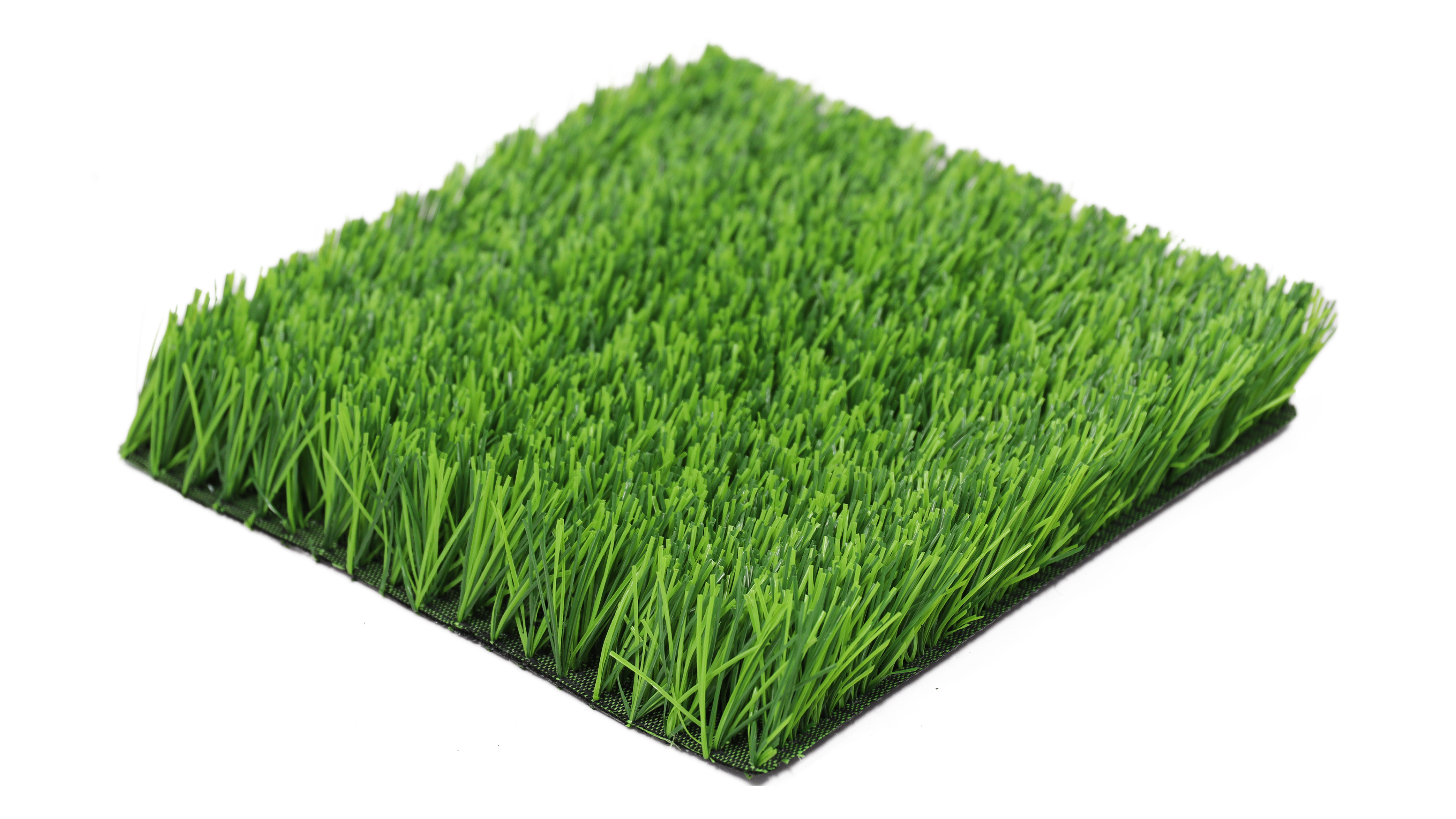
A compliance file for artificial turf is the ordered set of documents that lets an approver confirm one thing: that the turf specified, the turf tested and the turf delivered are the same construction. It is assembled from model-level data — pile height, gauge, stitch rate and density, yarn type, backing system and intended application — and it is only as strong as the weakest field in it. This checklist shows how to build that file from product data, using two documented models as working examples: EM241007 at 45 mm with a Double PP backing and PU glue, and EM24071902 at 25 mm with a PP, net and latex backing.
Both are manufactured by Venusturf (Wuxi Venus Turf Co., Ltd.), an artificial turf manufacturer based in Wuxi, Jiangsu, China, which handles yarn extrusion, twisting, tufting, coating and packaging across 30 integrated production lines and exports the majority of its output to global markets. The two models are useful because their specifications sit at opposite ends of the same range: one is a 45 mm landscape-oriented construction, the other a 25 mm commercial construction with a different backing system and a higher stitch density. Everything below is drawn from those product records and from published standards; where a field is not documented, the checklist says so instead of filling the gap.
What a turf compliance file actually has to prove
Three different questions are usually bundled into the single word "compliance", and most rejected submittals fail because the answer to one is offered as the answer to another.
- Specification conformity. Does the delivered roll match the construction that was specified — same model code, same pile height, same gauge, same yarn description, same backing system?
- Evidence coverage. Is there a test document that covers the attribute the project cares about, on a sample of that construction, tested to a named standard and edition?
- Project acceptance. Does the buyer's own requirement set — regional rules, client specification, tender document, facility operator standard — accept that evidence as sufficient?
A product can conform to its own datasheet and still fail acceptance, because the datasheet was never designed to answer the second and third questions. The compliance file exists to close that distance. It is not a marketing document and does not need to be long; a well-built file for a single model is usually six to twelve pages once the specification record, the evidence documents and the requirement matrix are attached.
Why turf documentation is easy to get wrong
Artificial turf is a layered product, and each layer can change independently of the others. The visible face is a yarn; beneath it sit a primary carrier, a coating or binder that locks the tufts in place, and in many constructions an additional reinforcement layer. Two rolls can look identical in colour and pile height and still be different products, because the yarn cross-section, the polymer blend, the number of backing layers or the binder chemistry has changed. That is why the specification record has to describe the construction rather than the appearance.
The standards landscape is equally easy to misread. ASTM's public listing of artificial turf surfaces and systems standards covers, among other areas, impact attenuation, lead content in fibers, permeability, hazardous metals in infill, abrasiveness, field sampling, surface characterization, filament bind, PFAS sampling, sieve analysis and PAH content. That listing includes different statuses and publication years, and the applicability of any individual standard has to be checked before procurement. In other words, the existence of a standard family is not evidence that a specific product has been tested to it.
Performance standards work at a different level again. The FIFA Quality Programme for Football Turf, for example, sets a vertical ball rebound range of 0.60 m to 0.85 m for certified surfaces. No pile height, yarn type or density figure on a datasheet proves that range; it is a measured behaviour of the installed system, including the base and any shockpad. A submittal that answers a pitch-performance requirement with a product parameter has answered a different question.
Application breadth compounds the problem. Artificial turf is described in published market research as being used across sports stadiums, residential lawns, commercial landscapes, playgrounds and recreational facilities. Those five settings do not share one acceptance standard, one wear pattern or one safety concern. A catalogue type label such as "Residential Grass" records how a manufacturer positions a model; it does not restrict where the product may be used, and it does not authorise use either.
The four parts of a submittal-ready file
Build the file in four parts, in this order. Each part answers one question and feeds the next.
Part A — Identification. Model code exactly as printed on the datasheet, revision or issue date, colour, the supplier's type label, order reference and quantity. The purpose is traceability: if a query arises six months after delivery, the file must show which construction was approved. Record the type label verbatim, including any trailing wording, and note that it is a positioning category rather than a use restriction.
Part B — Construction specification. Six fields plus one statement of intended application. Record each with its unit and do not paraphrase the supplier's wording.
| Field | What to record | Why the approver needs it |
|---|---|---|
| Pile height | Millimetres, as a single figure | The most-quoted field and the least diagnostic on its own; it sets the visual and contact character but says nothing about yarn quality or density |
| Gauge | Inches, with the millimetre equivalent | Row spacing of the tufting; needed to check stitch density and to compare two models fairly |
| Stitch rate and density | Stitches per metre and stitches per square metre | Tuft population per unit area; the field most often copied without checking whether both figures agree |
| Yarn | Form and polymer of each component, e.g. monofilament plus curled fibre | Distinguishes two constructions that share a pile height; also the field that must match a test report's sample description |
| Backing system | Layer count, reinforcement and coating chemistry | A different binder is a different product, even at identical face specification |
| Colour | Number of colours and reference | Approval item in most landscape and hospitality projects |
| Intended application | The stated application list, plus the project's own use | Shows where the supplier's stated scope ends and the project's assumption begins |
Part C — Evidence documents. Each document needs five identifiers: issuing laboratory, report number, standard or regulation with edition, issue date, and the sample identity it covers. Keep test reports and certifications in separate folders. A substance screening report and a surface-performance certification are not interchangeable, and a report issued on one construction does not automatically describe another.
Part D — Requirement matrix. One row per project requirement: the requirement, its source (tender clause, regional rule, operator standard), the document offered as evidence, and a status. Use four statuses only — met, not met, not applicable, not documented. The fourth status is the one that protects the buyer, and it is the one most submittals quietly omit.
Step-by-step: converting model data into a submittal
Step 1 — Lock the model code before anything else. Write the code exactly as the manufacturer issues it, and add the datasheet date. Model codes change when a construction changes; a quotation that names only "45 mm landscape grass" has not identified a product. Where a supplier publishes a type label alongside the code, record both and treat the label as classification, not as scope.
Step 2 — Transcribe the six construction fields with units. Copy pile height in millimetres, gauge in inches with a millimetre equivalent, stitch rate, density, yarn description and backing description. Do not round and do not merge. If a datasheet gives 15,750 stitches/m², the file records 15,750 stitches/m², not "about 15,000".
Step 3 — Run the arithmetic consistency check. This is the fastest way to see whether a specification record was built from one construction or assembled from several sources. Gauge defines row spacing, so one metre of width holds approximately 1000 divided by the gauge in millimetres rows. Multiply that by the stitch rate per metre and you should recover the density figure.
- 3/8 inch = 9.525 mm, so roughly 105 rows per metre. EM241007: 150 stitches/m × 105 ≈ 15,750 stitches/m², which is the published density.
- EM24071902 uses the same 3/8 inch gauge: 180 stitches/m × 105 ≈ 18,900 stitches/m², again matching its record.
- 5/8 inch = 15.875 mm, so roughly 63 rows per metre. EM250105: 180 stitches/m × 63 ≈ 11,340 stitches/m².
- 3/16 inch = 4.7625 mm, so roughly 210 rows per metre. The Putt 40 golf model: 300 stitches/m × 210 ≈ 63,000 stitches/m².
When the three figures reconcile, the specification is internally coherent. When they do not, the likely cause is a difference in basis — some datasheets report stitch rate along a row, others across a metre of width — and the question to put to the supplier is which basis was used. Ask it before the submittal goes out, not after the rolls arrive.
Step 4 — Read the yarn and backing as construction, not as adjectives. A description such as "U shape with spine Monofil PE + Curled PP" names two components in the PE/PP polymer family: a profiled monofilament that carries most of the visible face, and a curled fibre that adds body at the base. A backing description such as "Double PP + PU glue" describes two polypropylene backing layers bonded with a polyurethane coating; "PP + Net + Latex" describes a polypropylene carrier with a net reinforcement and a latex binder. The file should record these as written. It should not translate them into performance claims, and it should not assume two binder chemistries are interchangeable for acceptance purposes — they are different delivered products even when the face specification matches.
Step 5 — Match the stated application to the project, and mark the difference. The stated application list on a datasheet is a scope statement by the manufacturer. If a model is listed for landscaping, sports, construction and hospitality, that supports a conversation about suitability; it does not by itself satisfy a pitch certification, a playground safety requirement or a facility operator's own standard. Where the project use is not explicitly within the stated list, write the gap into Part D rather than resolving it informally.
Step 6 — Attach evidence with its scope intact. For each document, record what was tested, to which standard, on which sample, by whom, and when. Then state plainly what the document does not cover. A substance screening report does not cover mechanical performance. A performance certification for one installed system does not cover a different backing. A test on a laboratory sample is not a test on a delivered roll. Preserving these boundaries is what makes the file usable by a third party who was not in the original conversation.
Step 7 — Map to the regional requirement list, line by line. Take the project's own list — tender clauses, client specification, regional market-access rules — and place each item against the evidence. Where a requirement is unfamiliar, confirm the current edition and its applicability with the issuing body or the project's technical advisor rather than inferring it from the product data. Where no document is offered, write "not documented". A submittal that lists five open items is more useful than one that claims twelve closed ones it cannot support.
Step 8 — Close the gaps in writing before award. Convert every "not documented" row into a written question with a deadline. Typical questions include: is the test report specific to this model and this backing, which laboratory issued it, which edition of the standard applies, and is there a separate report for the delivered construction. The answers belong in the file as an addendum, dated and signed, so the approved version and the delivered version remain linked.
Worked example: EM241007 and EM24071902
The two models make the method concrete because they differ in almost every field except gauge.
EM241007 is recorded at 45 mm pile height, 3/8 inch gauge, four colours, a yarn described as U-shape-with-spine monofilament PE plus curled PP, 150 stitches per metre and 15,750 stitches per square metre, on a Double PP backing with PU glue. Its stated applications are landscaping, sports, construction and hospitality, and the supplier's type label records it as residential grass. In a submittal, the 45 mm figure belongs in the specification record with the backing description attached, because the delivered construction is what the approver is accepting.
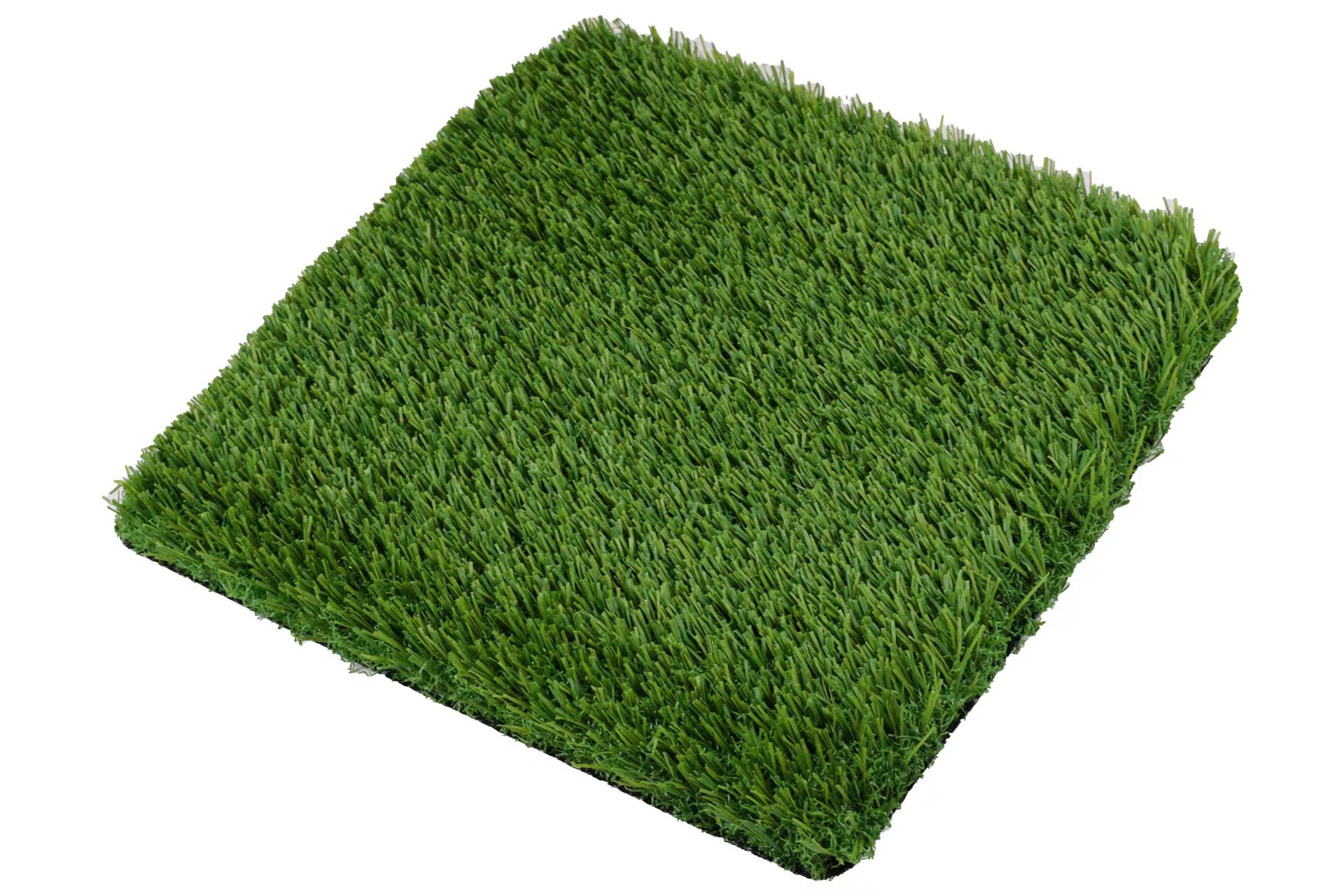
EM24071902 is recorded at 25 mm pile height, the same 3/8 inch gauge and four-colour yarn, a yarn described as U-shape monofilament PE plus curled PP, 180 stitches per metre and 18,900 stitches per square metre, on a PP backing with net and latex. Its type label is commercial grass. Notice the relationship: the shorter model carries the higher stitch density. That single comparison is enough to show why pile height cannot rank two products, and why a specification that names only pile height is not a specification.
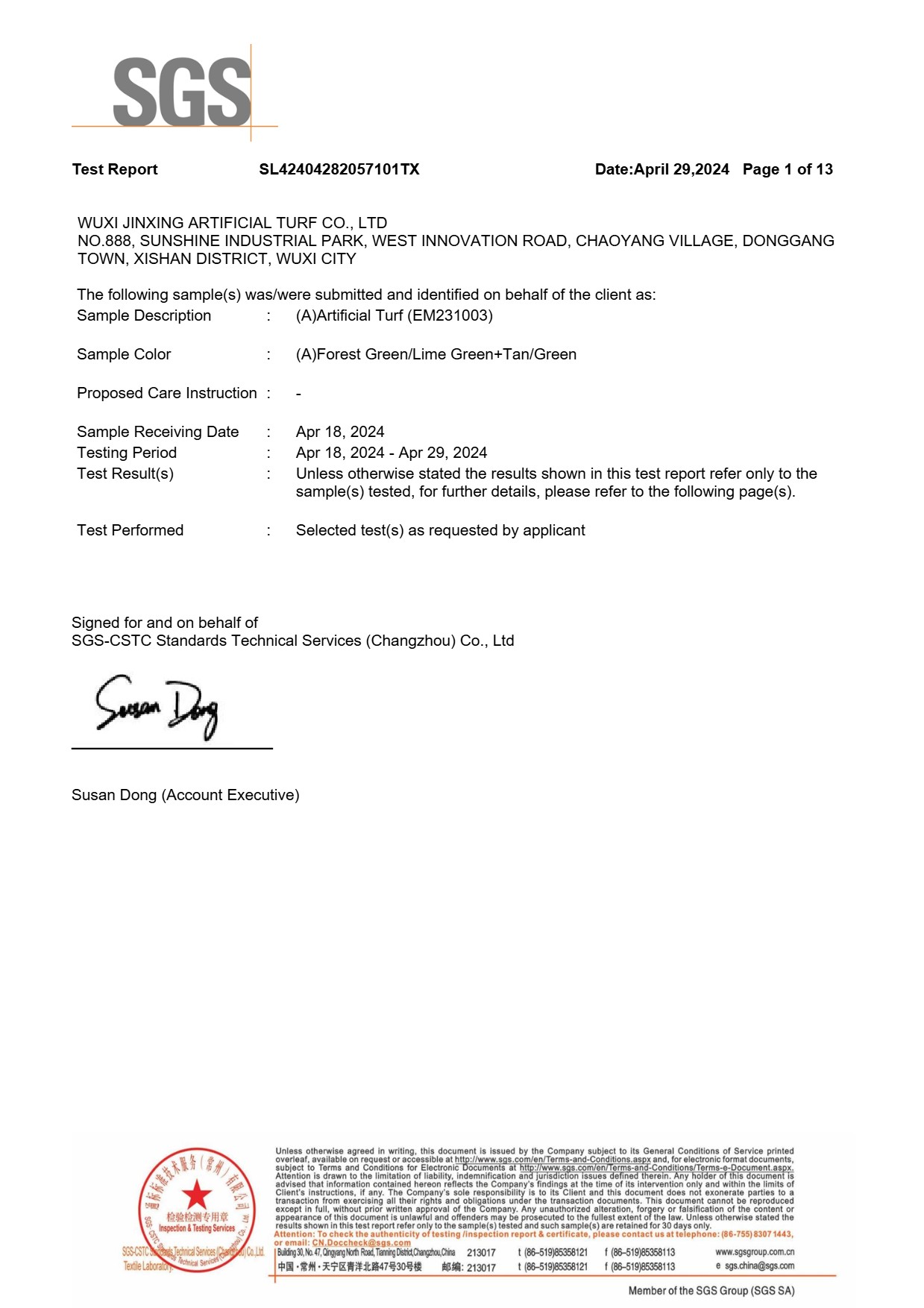
On evidence, the documented example in this range is a REACH SVHC 240 Substances Test Report issued by SGS under report number SL42404282057101TX, tested against REACH Regulation (EC) No 1907/2006 and issued on 29 April 2024, with a stated scope of REACH SVHC 240 substances testing for artificial turf. The supplied product record links this report to EM241007. Read that sentence as precisely as it is written: it is a substance screening report on a sample, linked to one model. It is not a surface-performance certificate, it does not cover ball behaviour, impact attenuation, permeability or abrasiveness, and it should not be presented in a submittal as a general compliance statement for the range. If the project requires a different model, a different backing or a different attribute, the honest entry in Part D is "not documented" until a matching report is supplied.
The supplier's own application record also lists in-house laboratory equipment including a tensile tester, a UV climate-resistance test chamber, a moisture tester and a spectral light box. That list is useful for one question in the submittal: which properties are checked in-house and which depend on a third-party report. In-house checks support batch consistency; they are not a substitute for accredited testing against a named standard, and the file should show the difference clearly.
Side-by-side specification record
The table below is the Part B section of a compliance file with both models placed side by side. Every value is taken from the product records as published; the right-hand column is the verification step the approver should apply to each row.
| Field | EM241007 | EM24071902 | Verification step |
|---|---|---|---|
| Pile height | 45 mm | 25 mm | Confirm the finished roll, not the catalogue page |
| Gauge | 3/8 inch | 3/8 inch | Convert to millimetres before comparing |
| Stitch rate | 150 stitches/m | 180 stitches/m | Ask whether the basis is per row or per metre of width |
| Density | 15,750 stitches/m² | 18,900 stitches/m² | Recompute from gauge and stitch rate |
| Yarn | U shape with spine Monofil PE + Curled PP | U shape Monofil PE + Curled PP | Match the wording against any test report sample description |
| Backing | Double PP + PU glue | PP + Net + Latex | Treat a binder change as a new product for approval |
| Colour | Four colour | Four colour | Confirm against the approved sample |
| Stated application | Landscaping, sports, construction, hospitality | Landscaping, sports, construction, hospitality | Compare with the project use and record any gap |
| Type label | Residential grass | Commercial grass | Record verbatim; do not treat as a use restriction or a permission |
Where the checklist shifts by project type
The six fields stay the same across project types; the weight attached to each one does not. Four patterns are worth planning for.
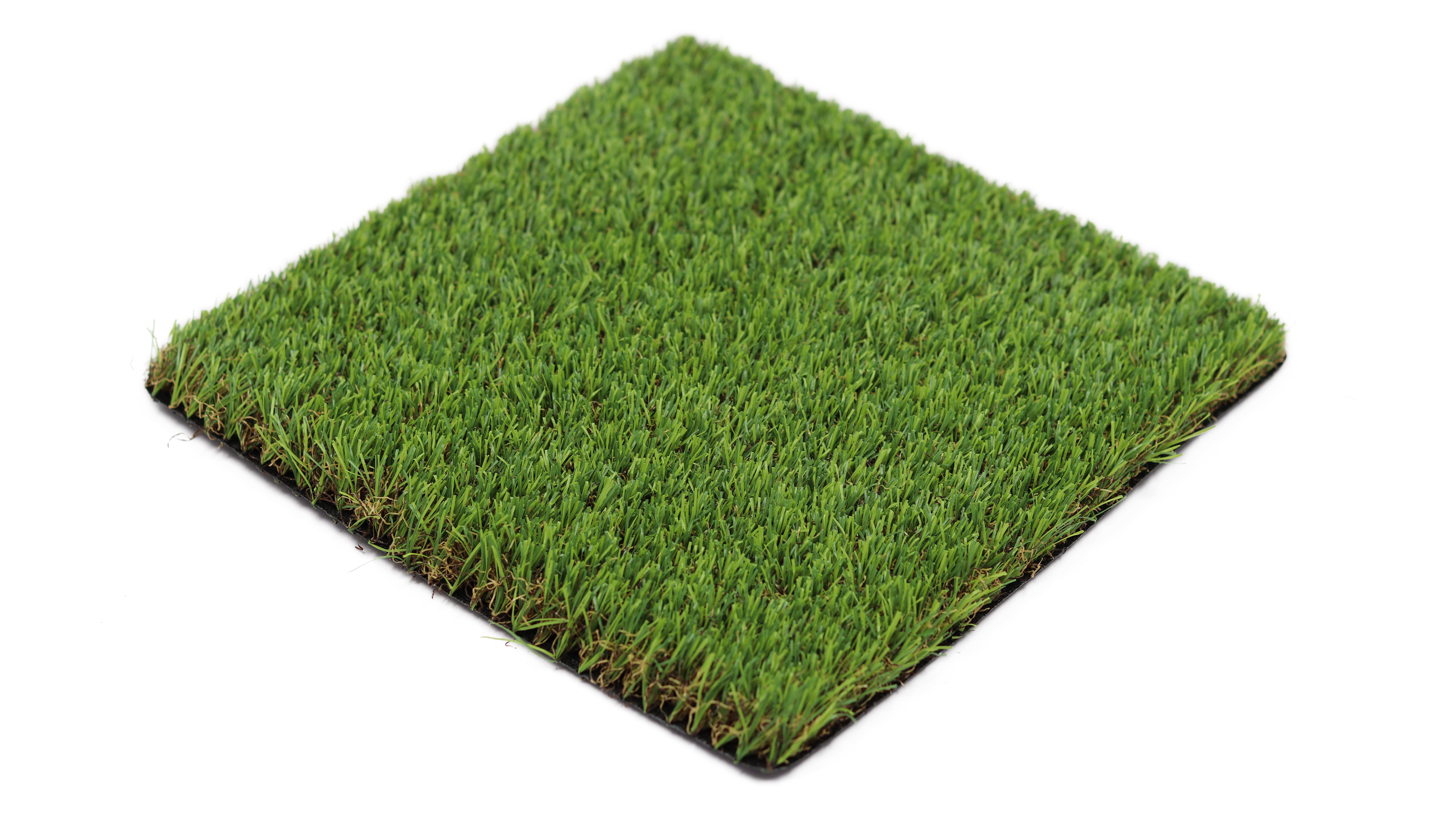
Sports pitches and training areas. Surface behaviour dominates. A football construction such as EM250105, recorded at 50 mm pile height on a 5/8 inch gauge with a U-with-spine monofilament PE yarn, 180 stitches per metre, 11,340 stitches per square metre and a PP plus mesh plus SBR latex backing, still needs its performance evidence handled separately from its specification. Where a governing-body requirement applies, the file needs the measured test result from the installed system, not a calculation from the yarn specification.
Commercial and hospitality landscape. Here the delivered construction matters most, because the approved appearance and the specified backing must both survive value engineering. A 25 mm commercial model with a PP, net and latex backing is a different acceptance object from a 45 mm residential model with a Double PP and PU backing, and a substitution between them is a specification change, not a colour variant.
Residential and pet areas. Buyer criteria shift towards cleaning, drainage and surface feel, but the documentation discipline does not change. A pet-oriented model such as EM24081501-1, recorded at 35 mm with a Double PP plus net plus pet glue backing and 10,500 stitches per square metre, should still appear in the file with its full construction and with the same evidence boundaries.
Golf and precision surfaces. Density and yarn form move to the front. The Putt 40 model is recorded at 15 mm pile height, 3/16 inch gauge, curled PE yarn, 300 stitches per metre and 63,000 stitches per square metre on a Double PP and PU glue backing — an order of magnitude denser than the landscape models above. When a project mixes a putting surface with a surround, build a separate Part B for each; one record covering both is a common and avoidable error.
Acceptance checks before you sign the submittal
- The model code is written exactly, with the datasheet date, and appears on the purchase order as well as the submittal.
- Pile height, gauge, stitch rate, density, yarn and backing are recorded with units and without rounding.
- Gauge, stitch rate and density reconcile arithmetically; if they do not, the basis question has been asked and answered in writing.
- Every test document carries laboratory, report number, standard with edition, issue date and sample identity.
- Substance screening, performance testing and certification are filed separately and described by what they cover.
- The stated application list has been compared with the actual project use, and any gap is written down.
- The requirement matrix uses four statuses only, and every "not documented" row has an owner and a deadline.
- The approved file, any addendum and the delivered construction reference the same model code.
Frequently asked questions
What documents should an artificial turf compliance file contain? Four groups: an identification sheet with the model code, revision and quantity; a construction specification covering pile height, gauge, stitch rate and density, yarn, backing and stated application; the supporting evidence, each document filed with its laboratory, report number, standard, edition, issue date and sample identity; and a requirement matrix that maps each project requirement to a document or to the status "not documented". Certifications, test reports and in-house checks should be kept in separate groups because they establish different things.
Can a supplier provide evidence for a specific model rather than for the whole range? That is the correct request, and the answer should be checked against the sample identity on the document rather than against the product family. In this range, the documented example is a REACH SVHC 240 substances test report from SGS, report number SL42404282057101TX, tested under REACH Regulation (EC) No 1907/2006 and issued on 29 April 2024, which the product record links to EM241007. Whether a performance test, a playground-safety assessment or a governing-body certificate exists for a particular model, backing and market must be confirmed in writing for that exact configuration before the submittal is issued.
How does the specification affect the budget? No price band is published in the product data used for this guide, and a compliance file should never carry a figure that is not traceable to a quotation. What the file can do is identify the fields that drive material consumption and therefore the quote: pile height, stitch density, yarn composition and backing construction all change how much material goes into a square metre, so a 45 mm model with a double backing and a PU coating and a 25 mm model with a net and latex backing will not price from the same rate. Ask for a quotation that names the model code and repeats the six construction fields, so the price and the approved product refer to the same object.
How should a sample be checked against the file? Compare the sample to Part B field by field rather than by appearance: measure pile height, confirm the yarn description and cross-section, check the colour count and confirm the backing layers and binder on the reverse face. Keep the approved sample labelled with the model code and the date, store it with the file, and treat any later sample that differs in backing or yarn form as a new submittal rather than a repeat.
What order quantity and lead time should be planned into the submittal timeline? For this manufacturer, the recorded minimum order quantity is 1,000 m², lead time is 30 to 45 days, and monthly capacity is stated at 50,000 m², with quality control recorded as 100% testing and OEM customisation available across appearance, specifications, performance and functionality, and the base and installation system. Build the evidence-gathering period on top of that window rather than inside it, since a report requested after the order is placed cannot influence the approval. To start a file for a specific project, send the model code, the project use and the requirement list to info@venusturf.com, or request a sample and a model-specific quotation through the company's contact channels.
Conclusion
A turf compliance file is not a thicker brochure. It is a short, ordered record that keeps three things aligned: the construction that was specified, the construction that was tested, and the construction that will be delivered. The six model-level fields do most of that work — pile height, gauge, stitch rate and density, yarn type, backing system and intended application — provided they are transcribed with units, checked against each other, and never allowed to stand in for evidence they cannot provide.
The two examples in this guide show why the discipline matters. EM241007 and EM24071902 share a gauge and a colour count and still differ in pile height, density, yarn form and binder; the shorter model is the denser one, and only one of them is linked in the supplied records to a substance test report. A buyer who records those differences, marks the unresolved rows as "not documented", and closes them in writing before award is doing the work that a submittal is supposed to do. A buyer who accepts a headline pile height and a logo on a certificate is relying on assumption.
For a fuller view of the manufacturer's range, production process and contact details, the company brochure can be downloaded here: Venusturf company brochure (PDF).
Next step: assemble Part A and Part B for your own project, and send the requirement list with the model code so that every evidence gap can be answered in writing before the submittal date.