
Artificial Turf Specs Decoded: Pile Height, Gauge, Density and Backing Systems
Date: 2026-11-09 Categories: Industry News Hits: 488
Artificial Turf Specs Decoded: Pile Height, Gauge, Density and Backing Systems
Two artificial turf quotations can show the same pile height, the same colour and the same photograph, and still land far apart on price. The difference is rarely visible in the picture. It sits in four lines of the datasheet: pile height in millimetres, tufting gauge in inches, stitch rate per metre, and the backing construction underneath. Read together, those four lines produce a performance profile you can compare. Read separately, they are just descriptions.
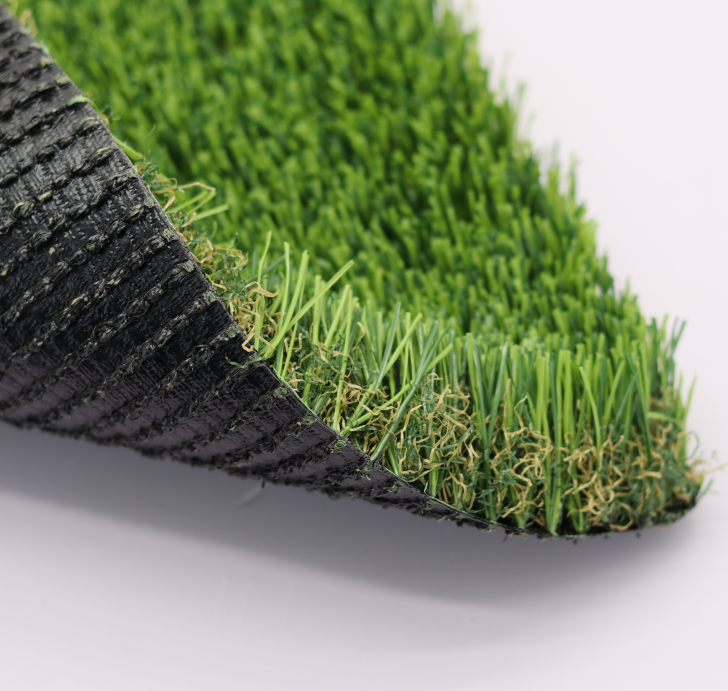
This guide works through each parameter, shows how to convert gauge and stitch rate into a single density figure, and then applies the method to six real Venusturf datasheets used as worked examples. Venus Turf is a Wuxi-based artificial turf manufacturer that runs yarn extrusion, twisting, tufting and coating in-house, so its model sheets are a useful teaching set: the parameters vary, but the way they are written does not.
Problem Definition: Why Turf Spec Sheets Are Hard to Compare
A specification sheet is written by people who already know the answer. That is the root of the problem. Buyers receive documents that are internally consistent but externally incomparable, and the mismatch shows up in three predictable ways.
- Mixed units. Gauge appears in fractions of an inch, stitch rate in stitches per metre or per 10 cm or per inch, density in stitches per square metre or per square yard, and yarn linear mass in dtex or denier. None of these convert mentally at the speed of a quotation review.
- Omitted parameters. Yarn linear mass (dtex), filament count, coating type and weight, perforation pattern, UV stabiliser package, drainage behaviour and warranty terms are frequently absent — and they are precisely the parameters that separate a five-year surface from a longer-life one.
- Application left unstated. A sheet can be technically complete and still not say what the product is for. That is not a product fault; it is a documentation gap, and it forces the buyer to guess.
The commercial consequence is straightforward. Buyers end up comparing price per square metre across products that are not equivalent, award the order on the lower headline number, and discover the difference at installation or in year three — when the infill no longer holds, or the backing has lost its dimensional stability.
Industry Background: Why Specification Literacy Now Matters More
Artificial turf is specified across a wide band of end uses. Market research on the category consistently lists sports stadiums, residential lawns, commercial landscapes, playgrounds and recreational facilities as the main application segments, and those segments have very different technical requirements from one another.
Demand is also fragmenting into sports-specific niches with their own surface logic. Padel court construction reached 77,300 courts globally by late 2025 and early 2026, according to the Playtomic and PwC Padel Global Report — a segment that asks for a short, dense and visually consistent surface rather than a deep football profile. Each new niche adds another set of specification conventions that buyers have to reconcile.
At the same time, the technical reference framework has matured. ASTM's artificial turf listing covers impact attenuation, lead content in fibers, permeability, hazardous metals in infill, abrasiveness, field sampling, surface characterization, filament bind, PFAS sampling, sieve analysis and PAH content. The standards cited in that listing include ASTM F1936-19, F3189-20, F2765-14(2021), F2898-11(2019), F3188-16(2021), F1015-21, F1551-23, F3383-19a(2025), F3640-23, F3496-20(2026), F3782-26 and F3846-26 — each addressing a different attribute, and none of them interchangeable with another.
For football, the FIFA Quality Programme for Football Turf sets performance requirements, including a vertical ball rebound between 0.60 m and 0.85 m under FIFA Quality Pro. What standards do not do is tell a buyer which pile height, gauge, density and backing combination will deliver that rebound on a given site. That remains a specification decision, and it begins with reading the sheet correctly.
Why full disclosure matters beyond price. A 2025 review by the New Jersey Department of Environmental Protection concluded that synthetic turf can provide functional and maintenance advantages over natural grass, while noting that installation and long-term use may raise complex environmental and public-health considerations, and that the evidence base remains limited and inconclusive across several reviewed topics. That conclusion is an argument for detailed, verifiable datasheets — not for avoiding the category.
Detailed Solution: The Four Numbers That Define a Turf Surface
1. Pile Height — A Dimension, Not a Quality Grade
Pile height is the height of the finished yarn above the primary backing, measured to the tip of the tuft in millimetres. In the six sheets used in this guide, pile height runs from 15 mm (Putt 40) through 25 mm (EM24071902), 30 mm (EM240404), 35 mm (EM24081501-1) and 45 mm (EM241007) up to 50 mm (EM250105).
What pile height actually changes:
- How much infill the surface can hold. A 50 mm football profile has physical room for a performance infill layer. A 15 mm putting surface has almost none, which is why putting turf is built dense rather than deep.
- How exposed the backing looks. At the same stitch count, taller yarns show more of the backing between tufts, which is one reason low-density tall turf reads as thin on site even when the density figure looks respectable on paper.
- Yarn consumption per square metre. Taller pile at equal density consumes more polymer per square metre. That is a cost line, not a quality line.
What pile height does not tell you is how dense the surface is. A 45 mm sheet and a 30 mm sheet can carry similar tuft counts per square metre and behave completely differently underfoot, under a ball and under a maintenance machine.
2. Gauge — The Number That Hides in Inches
Gauge is the distance between two adjacent needle rows on the tufting machine, normally written as a fraction of an inch. It is the single most overlooked parameter on a turf datasheet, and it sets a hard ceiling on how dense a surface can become.
Convert gauge to millimetres by multiplying the inch value by 25.4. Then divide 1,000 mm by that figure to get the number of stitch lines per metre of width.
| Gauge (inch) | Gauge (mm) | Stitch lines per metre of width | Density ceiling at 150 stitches/m |
|---|---|---|---|
| 3/16 in | 4.76 mm | ≈ 210 | ≈ 31,500 / m² |
| 3/8 in | 9.53 mm | ≈ 105 | ≈ 15,750 / m² |
| 5/8 in | 15.88 mm | ≈ 63 | ≈ 9,450 / m² |
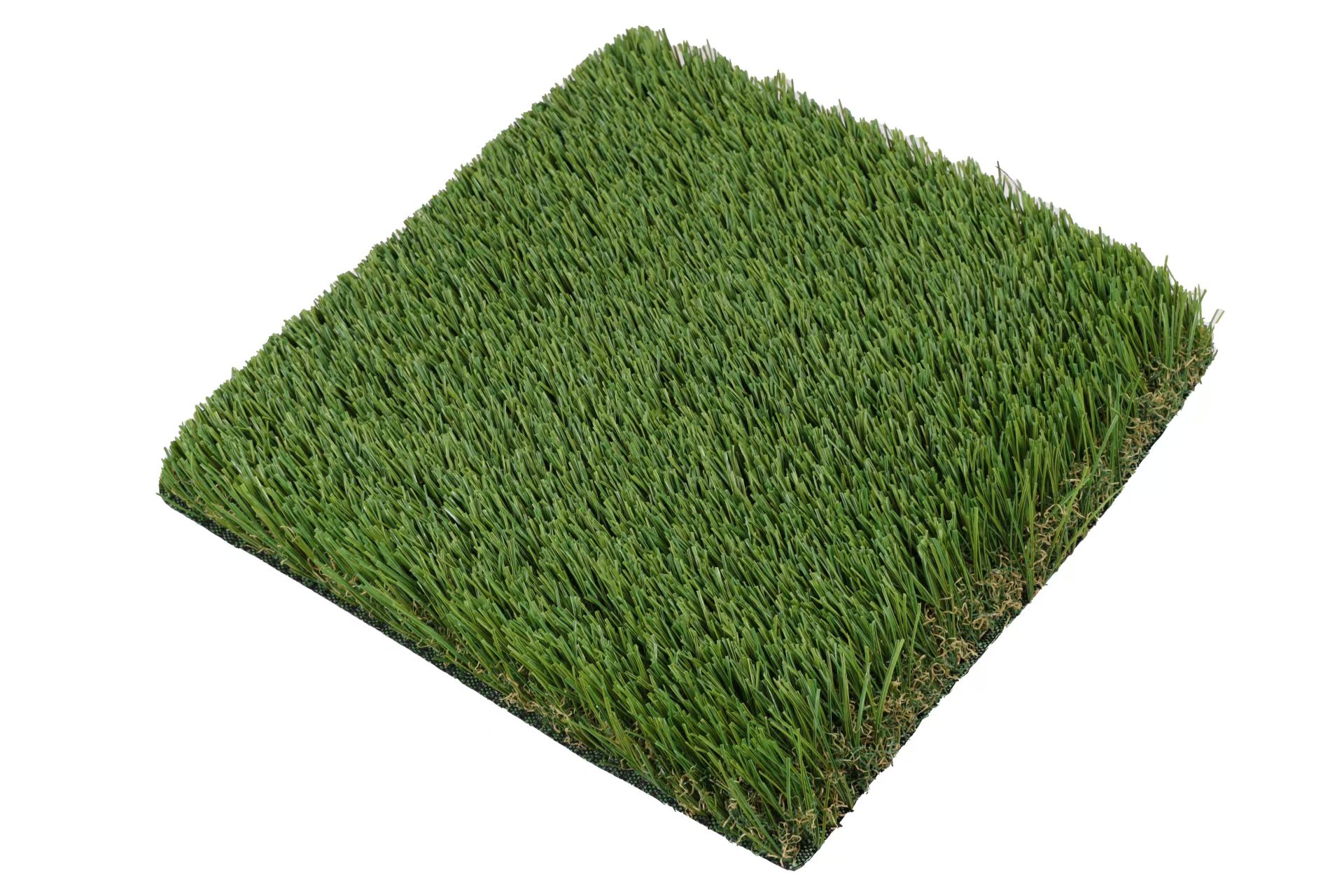
A 5/8 inch machine can only place about 63 stitch lines across a metre. A 3/16 inch machine can place about 210. Stitch rate can be raised on either, but the density outcome will never be comparable. This is why two sheets can both claim "high density" and be describing products that differ by a factor of three.
3. Stitch Rate and Density — One Formula, No Ambiguity
Stitch rate is the number of tufts per metre of length. Some sheets express it per 10 cm or per inch, so convert first: per 10 cm multiplied by 10, or per inch multiplied by 39.37, gives stitches per metre.
Density is then pure arithmetic:
Worked example — EM250105 football turf. The sheet states a 5/8 inch gauge, 180 stitches per metre and 11,340 stitches per m². Check it: 5/8 inch is 15.88 mm, so 1,000 ÷ 15.88 ≈ 63 stitch lines per metre of width. 180 × 63 = 11,340. The sheet is internally consistent.
Worked example — EM240404. A 3/8 inch gauge is 9.53 mm, giving ≈ 105 stitch lines per metre. At 140 stitches per metre, 140 × 105 = 14,700 stitches per m² — exactly the published density.
Reverse check — Putt 40 golf putting turf. A 3/16 inch gauge gives ≈ 210 stitch lines per metre. The published 63,000 stitches per m² therefore implies roughly 300 stitches per metre of length. That is an unusually high rate, and it is only viable because the pile is 15 mm: short yarn does not need to hold itself upright over a long span.
Back-calculation — EM241007, EM24071902 and EM24081501-1. None of these three sheets states a gauge, but their published figures are 15,750 stitches/m² at 150 stitches/m, 18,900 at 180, and 10,500 at 100. All three divide to 105 stitch lines per metre, which corresponds to a 3/8 inch gauge. This is a genuinely useful procurement check: if a supplier's density and stitch rate do not divide into a plausible gauge, one of the three numbers is wrong.
The pattern across the six sheets. Four of the six sit on the same 3/8 inch foundation and differ mainly in stitch rate and pile height. Only two break the pattern: Putt 40 on a fine 3/16 inch gauge for a short putting surface, and EM250105 on a coarse 5/8 inch gauge for a 50 mm football profile. That is what product differentiation looks like in specification terms — not a new colour name.
4. Yarn Shape and Composition — What Decides How It Ages
The yarn line is where most sheets become vague. Three of the models here state it precisely:
- EM241007 — U-shape with spine, monofilament PE plus curled PP.
- EM240404 — C-shape monofilament PE and curled PP.
- EM24071902 — four-colour construction.
Monofilament is a single extruded strand; the profile shape is a structural decision. A U-profile with a spine stiffens the blade and gives it a defined memory after compression, which is why it is used where the surface must keep standing upright. A C-profile is an open shape with a different balance of softness and recovery. Curled PP is a crimped, texturised fibre used alongside the monofilament to add body and coverage, so the finished surface reads as full rather than sparse.
A four-colour construction such as EM24071902 is primarily an appearance decision: colour variation across tufts reads as a more natural surface and changes how seams and traffic patterns show up compared with a single-colour sheet.
What is missing from all three yarn descriptions is dtex — the linear mass of the yarn — and filament count. Those two figures determine how much polymer sits in each stitch and therefore how the surface performs under sustained traffic. A sheet that names the shape but omits dtex is a partial sheet, regardless of how professional it looks.
5. Backing Systems — Where Durability and Drainage Are Actually Decided
Three backing constructions appear in this model set:
- Double PP + PU glue — EM241007.
- PP + Mesh + SBR latex — EM240404.
- Double PP + Net + pet glue — EM24081501-1.
Read each as three layers in sequence. The primary carrier is the woven polypropylene fabric the tufts are punched through. The secondary layer — mesh or net — is an open structure that acts as a drainage path and a dimensional stabiliser. The coating — PU glue, SBR latex or a pet-specific glue — locks the tufts into the carrier and holds the roll's dimensions through temperature change and installation tension.
PU coating is generally selected for flexibility and dimensional stability. SBR latex is a widely used coating with a different cost and hand-feel profile. A mesh or net secondary layer changes how quickly water passes through the backing, which is why backing choice and drainage design are one decision rather than two. Where a sheet names a pet-specific glue, the right question is not "is it better?" but "which property does it change, and which test shows it?"
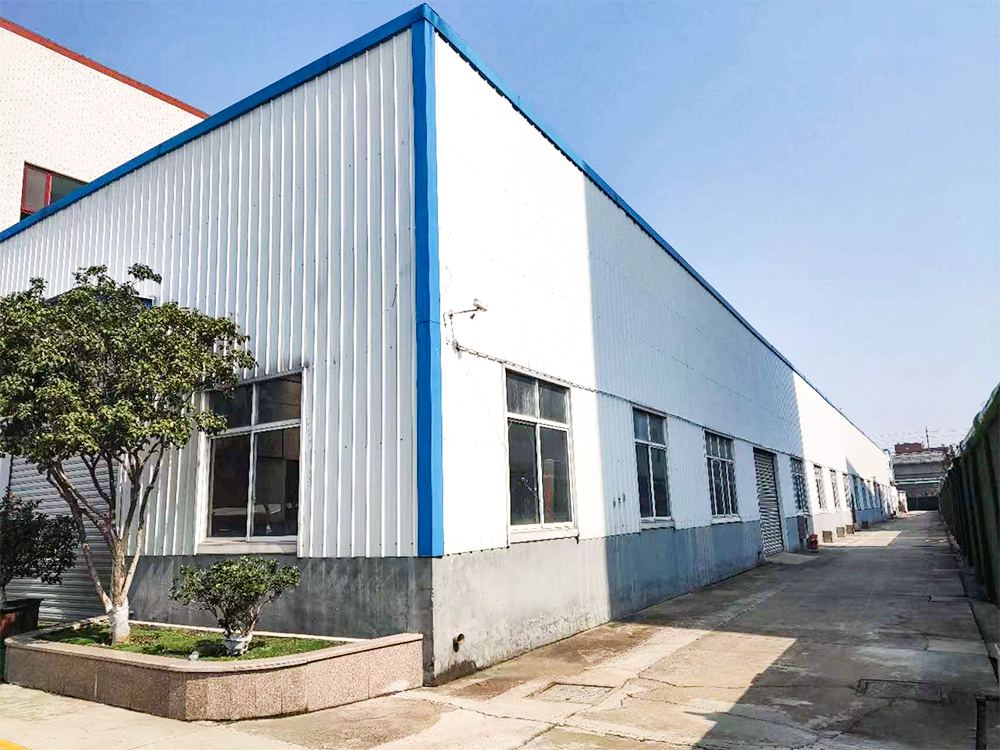
Drainage is a data request, not an adjective. Hydrological modelling of artificial turf requires determination of an effective curve-number (CN) value, and technical documentation notes that this value is sometimes only obtainable from the turf supplier. If a quotation arrives without drainage data, the civil design has a gap in it — and no amount of "excellent permeability" wording closes that gap.
Step-by-Step: Reading Any Turf Spec Sheet in Eight Passes
- Fix the units before anything else. Convert gauge to millimetres, stitch rate to stitches per metre, density to stitches per m², yarn to a single linear-mass unit. Do this once, in a spreadsheet, and every later comparison becomes mechanical.
- Record pile height in millimetres. Ignore any descriptive label attached to it.
- Convert gauge into stitch lines per metre of width using 1,000 ÷ gauge in mm.
- Recompute density yourself. Multiply stitch rate by stitch lines per metre. If the result does not match the published density, stop and ask which number is correct.
- Read the yarn line for shape, polymer and dtex. If dtex is absent, mark the sheet as incomplete rather than assuming an average value.
- Read the backing line by layers — carrier, secondary layer, coating. Note whether the secondary layer is open (mesh, net) or closed.
- List what the sheet does not state — dtex, filament count, perforation pattern, drainage data, UV stabiliser approach, warranty, and the application the product was designed for.
- Normalise the quotation. Compare price per m² only at equal pile height, equal density and equal backing. Where density differs, price per m² is not a comparison at all.
Six Datasheets, One Table: How the Parameters Combine
The table below uses only the parameters published on each sheet. Values marked with an asterisk are arithmetic derived from the stated figures, not additional manufacturer data.
| Model | Pile height | Gauge | Stitch rate | Density | Yarn construction | Backing system | Application stated on sheet |
|---|---|---|---|---|---|---|---|
| EM250105 | 50 mm | 5/8 in (15.9 mm) | 180 / m | 11,340 / m² | Not stated | Not stated | Football turf |
| EM241007 | 45 mm | 3/8 in* (9.5 mm) | 150 / m | 15,750 / m² | U-shape with spine; monofil PE + curled PP | Double PP + PU glue | Not stated |
| EM24081501-1 | 35 mm | 3/8 in* (9.5 mm) | 100 / m | 10,500 / m² | Not stated | Double PP + Net + pet glue | Pet grass |
| EM240404 | 30 mm | 3/8 in (9.5 mm) | 140 / m | 14,700 / m² | C-shape monofil PE + curled PP | PP + Mesh + SBR Latex | Not stated |
| EM24071902 | 25 mm | 3/8 in* (9.5 mm) | 180 / m | 18,900 / m² | Four-colour | Not stated | Commercial |
| Putt 40 | 15 mm | 3/16 in (4.8 mm) | ≈ 300 / m* | 63,000 / m² | Not stated | Not stated | Golf putting turf |
* Derived by calculation from the published density and gauge/stitch rate. Not additional manufacturer data.
Use Cases: What Each Combination Is Actually For
Football and Sports Pitches — EM250105
50 mm pile on a 5/8 inch gauge at 180 stitches per metre gives 11,340 stitches per m² — the lowest density in this set, and deliberately so. A coarse gauge at tall pile leaves room for a performance infill layer, and infill is what governs ball behaviour on a football surface. That is the mechanism behind the FIFA Quality Pro vertical ball rebound window of 0.60 m to 0.85 m. The datasheet alone does not demonstrate compliance: the rebound figure belongs to the installed system, with its infill and base, not to the roll in isolation.
Golf Putting Surfaces — Putt 40
15 mm pile on a 3/16 inch gauge at 63,000 stitches per m² produces the densest surface in this set by a wide margin. Fine gauge plus short pile is the standard logic for putting turf: a high tuft count delivers a consistent, low-shear surface without relying on infill to hold the yarn upright.
Pet Applications — EM24081501-1
35 mm pile at 100 stitches per metre gives 10,500 stitches per m², combined with a Double PP + Net + pet glue backing. Two details deserve scrutiny in a pet specification: the open net secondary layer, which affects how the backing handles water, and the named pet-specific coating, which should be supported by a stated property rather than by the product name alone.
Commercial Surfaces — EM24071902
25 mm pile at 180 stitches per metre reaches 18,900 stitches per m² — the second highest density here, at a short pile, in a four-colour construction. This is the profile of a surface built for foot traffic and appearance retention, where a dense short pile keeps its look and resists visible tracking.
The Two Sheets That Do Not Declare an Application
EM241007 (45 mm, 15,750 stitches/m², Double PP + PU glue, U-shape with spine yarn) and EM240404 (30 mm, 14,700 stitches/m², PP + Mesh + SBR latex, C-shape yarn) are technically described but not application-labelled. That is not a product defect — it is a documentation gap, and it is the buyer's job to close it with a direct question before shortlisting. A supplier who cannot state the intended application for a 45 mm, 15,750-stitch product is telling you something about how the datasheet was written.
How Yarn, Gauge, Density, Infill and Drainage Interact
The parameters are not independent, and treating them as a checklist is how buyers get caught out.
- Density × pile height × dtex = yarn mass per m². This is the real cost driver, and it is why a 25 mm product at 18,900 stitches/m² and a 50 mm product at 11,340 stitches/m² can consume very different amounts of polymer despite similar-looking sheets.
- Pile height sets the infill budget. Deep pile needs infill to stabilise the yarn and deliver ball behaviour. Short pile tolerates little or none, which pushes the performance burden onto density and yarn profile instead.
- Backing sets the drainage path. Mesh and net secondary layers are open structures; coatings and perforation patterns determine how fast water leaves the surface. The effective curve number used in runoff modelling is supplier-dependent data, so it belongs in the RFQ.
- UV exposure is a separate control. Colour loss and ageing are managed through UV stabilisers, anti-UV additives and UV-resistant masterbatch during production, and verified through accelerated ageing testing and colour-fastness quality control. A density figure says nothing about UV performance, so it should be specified separately.
- Feel is not a number. University extension guidance notes that synthetic turf has an artificial, unnatural feel and a strong odour, particularly where rubber infill is used. Buyers specifying for hospitality, residential or indoor venues should weigh that against the visual advantage the same guidance lists — a surface that looks green all year.
Frequently Asked Questions
Which standards and test methods should an artificial turf spec sheet reference?
ASTM's artificial turf listing covers impact attenuation, lead content in fibers, permeability, hazardous metals in infill, abrasiveness, field sampling, surface characterization, filament bind, PFAS sampling, sieve analysis and PAH content, and cites standards including ASTM F1936-19, F3189-20, F2765-14(2021), F2898-11(2019), F3188-16(2021), F1015-21, F1551-23, F3383-19a(2025), F3640-23, F3496-20(2026), F3782-26 and F3846-26. These cover different attributes and are not interchangeable certifications, so a sheet should name the specific test method behind each performance claim. For football, FIFA Quality Pro specifies a vertical ball rebound between 0.60 m and 0.85 m — a property of the installed system rather than of the roll alone.
Can pile height, gauge and backing be combined to match a specific project requirement?
The six sheets in this guide span that range in practice: from 15 mm pile on a 3/16 inch gauge at 63,000 stitches/m² for putting surfaces, to 50 mm on a 5/8 inch gauge at 11,340 stitches/m² for football, with PU glue, SBR latex and pet-glue backings in between. Venus Turf (Wuxi Venus Turf Co., Ltd.) carries out yarn extrusion, twisting, tufting and coating in-house across 30 integrated production lines, with a 25-engineer R&D team — the stage of production where pile height, gauge, yarn profile and coating are fixed. When specifying, state pile height, gauge, stitch rate, density, dtex and coating type, and ask for written confirmation of each.
Does a higher stitch density always mean a higher price?
Not on its own. Yarn mass per square metre is the underlying cost driver, and it combines pile height, density and yarn linear mass (dtex). A 25 mm surface at 18,900 stitches/m² and a 50 mm surface at 11,340 stitches/m² can consume materially different amounts of polymer, so price per square metre only becomes comparable once pile height, density and backing are equalised. Venus Turf's stated commercial terms for quotation are a minimum order quantity of 1,000 m², FOB delivery, and 30% TT as deposit with 70% TT before delivery.
How can a buyer verify a spec sheet before placing an order?
Request a physical sample and check it against the document: measure pile height directly, count stitch lines across a 100 mm width to confirm the stated gauge, and cut the edge to inspect the backing layers and coating. Then write pre-shipment testing into the order as the acceptance criterion, so the delivered roll is checked against the same parameters rather than against a marketing description. Samples and specification confirmations for the models discussed here can be requested from the Venus Turf technical team at info@venusturf.com or via WhatsApp on +8618961718197.
What are the acceptance and payment terms, and how is lead time handled?
Venus Turf's stated terms are a 1,000 m² minimum order quantity, FOB delivery, pre-shipment test as the acceptance criterion, and 30% TT deposit with 70% TT before delivery. Lead time is not fixed by a datasheet — it follows the specification, backing type and order volume — so it should be confirmed in writing against the production schedule at the time of ordering rather than assumed from a previous order.
Compare specifications, not adjectives
Send us your project parameters — pile height, gauge, stitch rate or density, yarn requirement and backing preference — and the Venus Turf team will match them against the model range, confirm each figure in writing, and dispatch a physical sample for verification before you commit to a quotation.
Visit www.vtsyntheticturf.com Download the product catalogue (PDF)Email: info@venusturf.com | Tel: +86-189-6171-8197 | WhatsApp: +8618961718197 | No. 888, Sunshine Industrial Park, Chuangxin West Road, Xishan District, Wuxi City, Jiangsu, China
Conclusion
Pile height decides how much room a surface has for infill. Gauge decides how many stitch lines can exist across a metre. Stitch rate multiplied by stitch lines gives density — a single number that can be checked in seconds and cannot be argued with. Backing construction decides whether the surface keeps its dimensions and how fast water leaves it. Yarn profile and dtex, once disclosed, explain how the surface will behave in year three rather than on the day of installation.
The six datasheets in this guide show what that looks like in practice: four products sharing a 3/8 inch foundation and diverging by stitch rate and pile height, one fine-gauge putting surface at 63,000 stitches/m², and one coarse-gauge football profile at 11,340. None of those figures is a quality verdict on its own. Together they are a specification, and a specification is the only basis on which two turf quotations can honestly be compared.
Before the next quote review, run the eight-pass check and mark every field the supplier left blank. The gaps are usually where the price difference lives.