
Residential, Commercial and Sports Artificial Turf: Five Specs Compared
Date: 2026-11-24 Categories: Industry News Hits: 90
Five artificial turf specifications can look interchangeable on a quotation sheet and behave nothing alike on site. Venusturf's EM241007 residential model is built on a 45 mm pile at 15,750 stitches/m² with a Double PP + PU backing; the Putt 40 golf surface uses a 15 mm pile at 63,000 stitches/m² with the same Double PP + PU backing family. Similar backing, very different surface: one is built to read as a lawn underfoot, the other to hold a short, dense face for golf work.
That contrast is the argument of this comparison. Residential, commercial, pet, golf and football turf are sold under one category name and are usually shortlisted on price per square metre. They are better compared on four construction fields — pile height, stitch density, yarn and backing build, and the traffic the surface is expected to absorb — because those fields determine what a roll can plausibly do before price becomes a meaningful number.
The five models examined here come from one manufacturer's range, which makes the comparison cleaner: the differences below come from construction choices rather than from five different companies describing themselves differently. Venusturf (Wuxi Venus Turf Co., Ltd.) is an artificial turf manufacturer based in Wuxi, Jiangsu, China, running 30 integrated production lines that cover yarn extrusion, twisting, tufting, coating and packaging, with a 25-engineer R&D team and roughly 80% of output exported. Its product range and company profile are published at vtsyntheticturf.com. The models are compared as constructions, not ranked against each other.
Why a price-per-square-metre comparison misleads
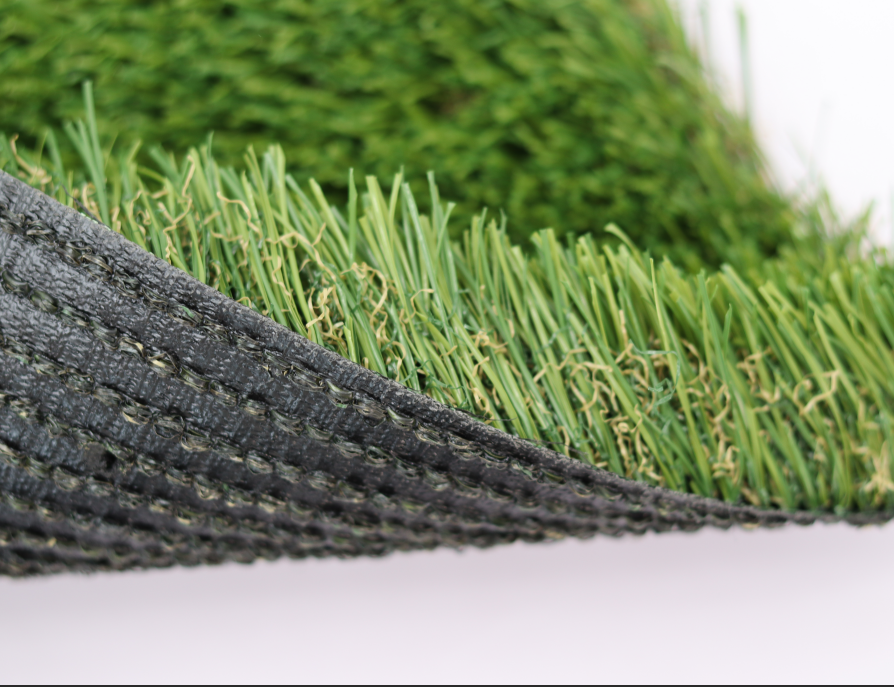
A square metre of artificial turf is not a fixed unit of value. Two rolls at the same headline price can contain very different amounts of yarn, different backing chemistry and different reinforcement layers, and those differences decide how the surface feels, how it drains, how it holds a tuft, and what installation method it accepts.
The five specifications in this guide make the point quickly. The pet model, EM24081501-1, carries 10,500 stitches/m² at a 35 mm pile. The golf model, Putt 40, carries 63,000 stitches/m² at a 15 mm pile — four times the stitch count on less than half the pile height. Buying both by the square metre and comparing only the rate tells you nothing about why one is specified for a putting surface and the other for a garden with animals on it.
There is a second reason price sorting fails at the category level. Buyers often compare a residential quote against a commercial quote without checking that the two quotes describe the same backing build. A 25 mm commercial construction with a net reinforcement and latex binder and a 45 mm residential construction with a polyurethane backing are not substitutes, so a difference in rate is not a difference in margin or efficiency — it is a difference in what is being supplied.
The practical sequence is therefore: fix the application and traffic first, choose the construction that matches it, write that construction into the purchase order with verification methods, and only then negotiate. Price becomes comparable once the specification is comparable.
Industry background: one category name, five different jobs
Artificial turf is described in published market research as being used across sports stadiums, residential lawns, commercial landscapes, playgrounds and recreational facilities — a wide band of end uses sitting under a single product label. Buyers inherit that label and then discover that a residential lawn product, a pet-area product and a football pitch product are engineered to different priorities.
Market sizing in this category is also a poor guide to selection. Scope statements from commercial research publishers show that at least some headline figures bundle production, installation and maintenance into one value, which is why published totals for the same year can diverge sharply. For a facilities buyer choosing between five constructions, the useful evidence is the specification sheet and the test documentation, not a category-level market value.
What has changed for buyers is the granularity of the offer. A manufacturer running extrusion, twisting, tufting and coating in one plant can vary yarn, pile height, stitch density and backing independently, which is exactly why five products in one catalogue can be so different, and why the specification conversation matters more than the catalogue conversation.
The five specifications at a glance
The table below reproduces the stated construction fields for each model. Nothing has been added: where a field is not given here, it is not given in the specification either, and the sections that follow treat those gaps as items to confirm before ordering rather than as assumptions.
| Model | Category | Pile height | Stitch density | Yarn / backing build |
|---|---|---|---|---|
| EM241007 | Residential | 45 mm | 15,750 stitches/m² | Double PP + PU |
| EM24071902 | Commercial | 25 mm | 18,900 stitches/m² | PP + Net + Latex |
| EM24081501-1 | Pet | 35 mm | 10,500 stitches/m² | Double PP + Net + Pet glue |
| Putt 40 | Golf | 15 mm | 63,000 stitches/m² | Double PP + PU |
| EM250105 | Football | 50 mm | 11,340 stitches/m² | PP + Mesh + SBR Latex |
Reading the four fields that actually differ
Pile height sets the surface's visual and contact character
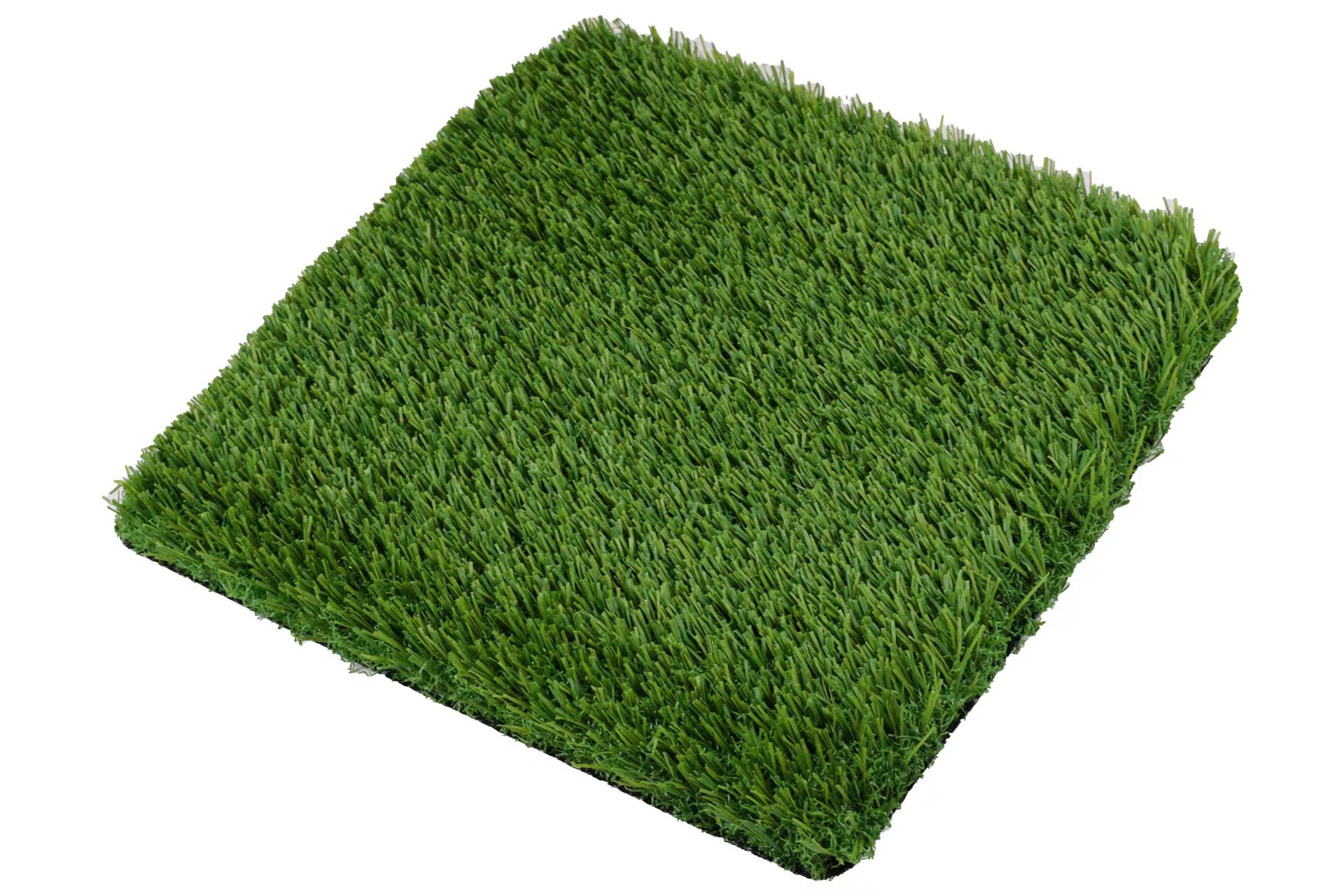
Pile height is the length of the yarn above the backing. Across these five models it spans 15 mm to 50 mm, and that range is doing most of the visual work. A 45 mm or 50 mm pile reads as a stand-up lawn or a playing surface; a 15 mm pile reads as a close, uniform mat.
Pile height also changes the mechanics of the finished system. Taller pile holds more air and more resilience underfoot, and in play applications it is normally combined with an infill to stabilise the fibres — although infill is a system decision that these five product sheets do not state. Short pile leaves less fibre to deflect, so the backing and stitch density carry proportionally more of the surface's behaviour.
The decision rule is straightforward: match pile height to the visual expectation and the contact the application demands, then check that the backing and density can support it. A 15 mm surface specified for a garden that should look like lawn will meet the technical requirement and miss the brief.
Stitch density is a separate axis, not a quality score
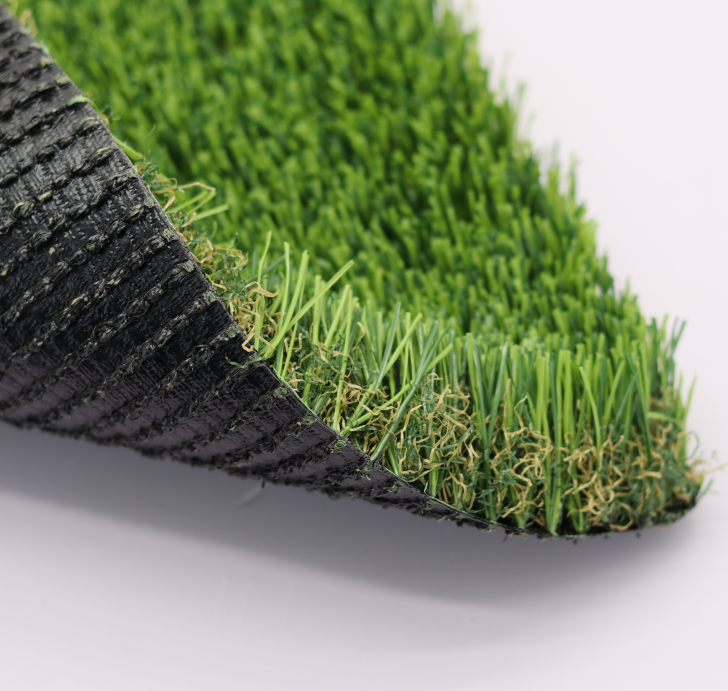
Stitch density, stated in stitches per square metre, describes how many tufts are inserted into a given area. It is the field buyers most often use as a proxy for quality, and that habit produces poor decisions. Putt 40's 63,000 stitches/m² is roughly four times EM241007's 15,750 stitches/m², but it would be wrong to conclude that the golf surface is four times better for a residential lawn; it is simply built for a different job, on a much shorter pile.
What density does tell you is how tight the face is. A tighter face at a given pile height produces a denser-looking, firmer surface; a looser face on a taller pile produces a softer, more open surface. The commercial model illustrates the interaction well: at 25 mm it carries 18,900 stitches/m², a higher count than the 45 mm residential model, so the commercial construction is tighter and shorter, not taller and heavier.
One caution for procurement: pile height and stitch density alone do not give face weight. Converting them into grams per square metre requires the yarn's linear density, which these sheets do not state. Any quotation that presents a face weight derived from only these two numbers should be queried.
The backing build decides how the roll behaves during and after installation
Every model in this comparison uses a polypropylene backing system, but no two are identical. The differences sit in the reinforcement layer and the binder:
- Double PP + PU (EM241007 residential, Putt 40 golf) — a two-layer polypropylene backing with a polyurethane coating. The same backing family appears at opposite ends of the pile and density range, which shows that backing is chosen for the tuft-lock and dimensional behaviour required, not for the category label.
- PP + Net + Latex (EM24071902 commercial) — a polypropylene backing with a net reinforcement and a latex binder, a common build where the surface must hold its shape across a large, continuously used area.
- Double PP + Net + Pet glue (EM24081501-1 pet) — two polypropylene layers plus net, bonded with a binder the specification names as pet glue. The designation records the build; it does not, on its own, establish odour, drainage or hygiene performance, which have to be verified separately.
- PP + Mesh + SBR Latex (EM250105 football) — polypropylene backing with a mesh reinforcement and styrene-butadiene rubber latex, a build associated with playing surfaces where the system must stay dimensionally stable under movement and load.
For the buyer, the practical consequence is that backing determines installation compatibility as much as performance. Base preparation, seaming method, adhesive choice and drainage design all key off the backing and coating, so a late substitution of backing build — even at the same pile height and density — changes the installation scope. That is why the backing line belongs in the purchase order, not only in the brochure.
What these five sheets do not state
Honest specification reading includes noting the absent fields. Across the five models, the stated data covers pile height, stitch density and backing build. It does not state yarn polymer or linear density, coating weight, roll width and length, drainage rate, infill recommendation, UV stabilisation package, warranty terms or test reports. None of those gaps is unusual for a product summary, and none of them can be filled by inference.
Two of them are worth prioritising. Yarn polymer and linear density determine whether the density figure translates into the face weight the project needs. UV stabilisation determines how the surface is expected to hold colour under exposure — Venusturf's own risk control for UV degradation, colour loss and weathering relies on UV stabilisers, anti-UV additives and UV-resistant masterbatch, backed by UV resistance testing, accelerated ageing tests and colour-fastness quality control. Buyers should ask for that evidence per model rather than assume it applies uniformly across a range.
Model by model: what each construction is built for
EM241007 — 45 mm residential
The residential model pairs the tallest pile outside the football surface, 45 mm, with a moderate 15,750 stitches/m² and a Double PP + PU backing. The construction leans towards appearance and underfoot softness: a longer fibre reads as lawn, and the polyurethane-coated double backing provides the tuft lock and dimensional stability that a domestic installation needs without the reinforcement layers used on heavy-traffic surfaces.
Its natural fit is residential grass and backyard use — gardens, terraces and domestic amenity areas where the surface is seen and walked on rather than trained on. Where a residential client also expects occasional heavy use, such as a family football kickabout area, the honest step is to raise the question with the supplier rather than assume a residential build absorbs it. This model is not stated as a sports surface.
EM24071902 — 25 mm commercial
The commercial model is the shortest pile in the set apart from golf, at 25 mm, with 18,900 stitches/m² and a PP + Net + Latex build. Short pile with a comparatively high stitch count produces a tight, even face; the net reinforcement and latex binder are the parts of the specification aimed at holding shape across a large area in continuous use.
That profile suits commercial grass and landscape applications — plazas, hospitality grounds, rooftops, show areas and shared amenity spaces where a uniform, low-maintenance finish matters and where the surface is specified as landscape rather than as a playing field. Buyers specifying for playgrounds, gyms or multi-purpose recreation should treat this as a starting reference and confirm the applicable safety, impact and drainage requirements separately, because a landscape specification and a play specification are not the same document.
EM24081501-1 — 35 mm pet
The pet model sits between the residential and commercial builds: a 35 mm pile at 10,500 stitches/m², the lowest stitch density in the comparison, on a Double PP + Net + Pet glue backing. The lower density on a mid-height pile gives an open, softer face, and the specified build adds both a net layer and a dedicated pet binder.
It is intended for pet grass areas, and the questions that matter in that application are not answered by the pile figures. Drainage rate, permeability, odour behaviour after use, seam integrity at high-traffic corners and cleaning method all need documentation. The specification records the binder type; it does not certify hygiene performance. Buyers should request the drainage and permeability data and confirm the cleaning regime the warranty assumes.
Putt 40 — 15 mm golf
Putt 40 is the outlier that makes the comparison useful. At 15 mm and 63,000 stitches/m² it delivers a very short, very dense face on a Double PP + PU backing — the same backing family as the residential model, at the opposite end of the pile and density range. The density is what makes a 15 mm surface playable rather than merely flat: there is enough fibre per square metre to present a consistent face at a height where a looser construction would show the backing through.
The model name and construction point to golf and short-game surfaces, including putting and practice work. Because the sheet does not state ball-roll performance, infill or the specific golf use it is intended for, buyers should confirm with the supplier whether it is specified for a putting green, a fringe or approach area, or a practice and hitting surface, and which performance values the project requires. Golf grass specifications are frequently written around roll and receptiveness rather than around pile figures, so the acceptance criteria need to be agreed explicitly.
EM250105 — 50 mm football
The football model is the tallest and the most heavily built in system terms: 50 mm pile, 11,340 stitches/m², and a PP + Mesh + SBR Latex backing. Tall pile at a moderate stitch count is the classic playing-surface balance — enough fibre length for play and underfoot behaviour, with a mesh-reinforced latex backing to keep the roll dimensionally stable across a pitch.
It is specified for football grass. Certification is a separate question from product specification: the FIFA Quality Programme for Football Turf, for example, sets performance requirements such as a vertical ball rebound of 0.60 m to 0.85 m for certified surfaces, and those are measured on the installed system, not on a roll. Adjacent sports — rugby, padel, tennis and multi-purpose surfaces — follow their own specification and certification paths, and this model should not be assumed to satisfy them.
A decision framework for outdoor sports and facilities buyers
Use the table as a first sort, then verify. The middle column names the construction reason, and the last column lists what must be confirmed before the model goes into a purchase order — in every case, the answer comes from the supplier's documentation, not from the pile figures.
| If the project is… | Start with | Construction reason | Confirm before ordering |
|---|---|---|---|
| A domestic garden or backyard where appearance dominates | EM241007 (45 mm, 15,750, Double PP + PU) | Longest pile short of the football build; soft lawn appearance with a coated double backing | Yarn polymer and face weight; UV and colour-fastness test data; seam and edge detail |
| A commercial landscape, plaza or hospitality area in continuous use | EM24071902 (25 mm, 18,900, PP + Net + Latex) | Short, tight face with net reinforcement and latex binder for shape retention over large areas | Drainage design and permeability; joint layout; cleaning and maintenance plan |
| A pet area or animal exercise space | EM24081501-1 (35 mm, 10,500, Double PP + Net + Pet glue) | Open mid-height face with a named pet binder and net layer | Permeability and drainage rate; odour and cleaning method the warranty assumes; seam strength |
| A golf putting, practice or short-game surface | Putt 40 (15 mm, 63,000, Double PP + PU) | Very high stitch count on a short pile to give a consistent, dense face | Intended golf use; roll or performance values required; infill or surface dressing |
| A football pitch or training field | EM250105 (50 mm, 11,340, PP + Mesh + SBR Latex) | Tall pile with a mesh-reinforced latex backing for a full-size playing surface | Certification route and installed-system testing; infill specification; base and shockpad design |
Trade-offs and limits worth writing into the file
Density and pile height trade against each other, and neither is free. Pushing density up at a short pile, as Putt 40 does, consumes more yarn per square metre than a taller, looser build; pushing pile height up, as EM250105 does, changes the fibre, infill and installation requirements. A specification that demands maximum pile height and maximum density together is asking for a different product from any of the five here, and should be tested against budget and installation reality before it is issued.
A category label is not a performance guarantee. The pet model's binder is named in the specification, but the sheet does not state hygiene, odour or drainage outcomes. The residential model's build suits domestic use, but it is not stated as a sports surface. Reading the label as a capability statement is the most common specification error in this category.
System performance is measured on the system. Football certification requirements such as the 0.60–0.85 m vertical ball rebound range apply to the installed pitch, including base, shockpad and infill — not to the roll. Playground surfacing, gym floors and multi-purpose courts have their own requirements again. A product sheet can support a submittal; it cannot replace installed-system testing where the project requires it.
Infill and material choice carry their own due diligence. Where rubber crumb infill is used, the evidence base is genuinely mixed and should be treated as such: a 2025 literature review found limited and inconclusive evidence of adverse health outcomes while noting that 9 of 18 reviewed laboratory studies reported PAH concentrations above recommended European guideline values, and a government review concluded that reviewed evidence did not show elevated health risks for outdoor and indoor fields while noting environmental risk from high zinc levels and recommending adequate ventilation indoors. University extension guidance also records an artificial feel and strong odour where rubber infill is used. These findings depend on material, exposure and field age, so the practical response is product-specific documentation — infill composition, origin, particle size and applicable test reports — rather than a category-level assurance.
Standards are not interchangeable. ASTM's artificial turf surfaces and systems listing covers impact attenuation, lead content in fibers, permeability, hazardous metals in infill, abrasiveness, field sampling, surface characterisation, filament bind, PFAS sampling, sieve analysis and PAH content across separate standards and test methods. Each addresses a different attribute; citing one does not establish the others, and the applicability and status of each must be checked for the specific project and market.
Aligning purchasing terms and acceptance criteria with the chosen specification
The gap between a chosen model and a delivered roll is closed by the purchase order, not by the brochure. Each stated field on the specification should appear in the order with a verification method attached. The checklist below is written to be copied into a tender or an RFQ and adjusted to the project.
1. Write the construction, not just the category
Name the model and restate the four fields: pile height in millimetres, stitch density in stitches per square metre, yarn specification and the full backing build (for example "Double PP + PU" or "PP + Mesh + SBR Latex"). Add yarn linear density and the resulting face weight once the supplier confirms them, and state that substitutions of backing build require written approval.
2. Agree how each field will be verified
Pile height: measured with a caliper or gauge at a stated number of points per roll, against a stated tolerance. Stitch density: counted over a defined area, at a stated number of positions, rather than accepted from the label. Backing: inspected for layer count, reinforcement presence and coating type. Roll dimensions, roll count and total area: reconciled against the order before shipment.
3. Attach the documentation you actually need
Ask for the model-specific technical datasheet, the UV and colour-fastness test evidence, and any third-party reports the project requires. Where the tender references ASTM methods, list the specific attributes to be tested — impact attenuation, permeability, lead content in fibers, hazardous metals or PAH content in infill, PFAS sampling — rather than citing the standards family. For football, state the certification route and the installed-system tests separately from the product specification.
4. Fix the acceptance point before production
Define whether acceptance happens at pre-shipment inspection, on delivery, or after installation, and who signs it. Retain a sealed production sample per model as the reference for any later dispute. Record packaging, labelling, roll marking and loading requirements, and confirm the base, drainage and installation method the backing assumes.
Frequently asked questions
What documentation should accompany an artificial turf order for a sports or landscape facility?
A model-specific datasheet stating pile height, stitch density, yarn and backing build; UV resistance and colour-fastness test evidence; and, where the project requires it, third-party reports covering the specific attributes named in the tender. ASTM's artificial turf listing covers impact attenuation, lead content in fibers, permeability, hazardous metals in infill, abrasiveness, field sampling, surface characterisation, filament bind, PFAS sampling, sieve analysis and PAH content as separate standards and methods — they are not a single compliance package, and each must be matched to the attribute it actually tests. For a football pitch seeking certification, installed-system performance testing is additional to the product documentation.
Can one of these constructions serve more than one application?
Partly, and only within documented limits. EM241007's 45 mm residential build can suit a range of domestic and amenity settings, and EM24071902's 25 mm commercial build can suit landscape areas in continuous use. But the five models differ in pile height, density and backing for reasons that follow traffic and use, and the sheets do not state performance outcomes for applications outside their category. Where a project mixes uses — a garden with a kickabout area, a commercial terrace with a play corner — the defensible approach is to confirm the intended use with the supplier in writing rather than to assume the nearest model covers it.
Why can't these five models be compared on price per square metre?
Because the same area contains different amounts of material and different backing chemistry. Putt 40 carries 63,000 stitches/m² at 15 mm; EM24081501-1 carries 10,500 stitches/m² at 35 mm. The yarn consumed, the reinforcement layers, the binder type and the installation method all differ, and installation cost follows the backing and base design rather than the roll alone. A rate is only comparable once pile height, stitch density, yarn and backing build are identical — which, across these five, they never are.
How should samples be evaluated across these specifications?
Evaluate samples against the fields that will be written into the order. Measure pile height at several points with a caliper rather than judging by eye; count stitches over a defined area and compare with the stated density; inspect the backing for layer count, the presence of net or mesh, and the coating type; and check that the sample is a production-run piece rather than a hand-made presentation swatch. Ask for the UV and colour-fastness evidence alongside the sample, and keep a sealed reference piece from the approved production batch so that later deliveries can be checked against it.
How should delivery scheduling and acceptance be structured to reduce risk?
Get the production and shipping schedule in writing before the order is confirmed, and treat it as part of the contract rather than as a courtesy. Fix the inspection point — pre-shipment is usually the most useful, because corrective action is still possible — agree who attends and what they check, and tie payment milestones to the inspection outcome rather than to the shipment date alone. Confirm packaging, roll marking and loading details at the same time. Then keep the retained sample and the inspection record with the project file, so that acceptance on delivery has a documented reference.
If the next step is a specification review for a specific project, Venusturf's team works from the construction fields rather than from a headline rate; the company profile and range are at vtsyntheticturf.com, and the full product brochure can be downloaded here: Venusturf artificial turf brochure (PDF).
Conclusion
Residential, commercial, pet, golf and football turf are not five grades of one product; they are five constructions answering different requirements. EM241007's 45 mm pile and 15,750 stitches/m² describe a lawn surface. EM24071902's 25 mm, 18,900-stitch build with net and latex describes a tight commercial landscape finish. EM24081501-1's 35 mm, 10,500-stitch open face with a named pet binder describes an animal area whose real questions are drainage and cleaning. Putt 40's 15 mm, 63,000-stitch face describes a golf surface where density substitutes for height. EM250105's 50 mm, 11,340-stitch build with mesh-reinforced latex describes a playing field that will be judged on installed-system performance.
Compare them on pile height, stitch density, yarn and backing first; align the purchase order and acceptance method to those fields second; and treat price as a comparison only once the specifications match. That sequence is what separates a specification-led purchase from a rate-led one.